Tuesday, January 6, 2026

Twelve Days of Christmas

Epiphany - Bright and Glorious is the Sky

The Epiphany, January 6, traditionally marks the end of Christmas and tells the story (from the Gospel of Matthew) of a star that announces the birth of a new King of the Jews, who is then visited by three wise men, or magi, from the East.

One of the most cherished Danish Christmas and Epiphany hymns is Dejlig er den himmel blå (Delightful is the Blue Sky) [traditional English version: Bright and Glorious is the Sky]. The text is by Nicolai F. S. Grundtvig (1783-1872), with music by Jacob Gerhard Meidell (1778–1857). Meidell’s simple and graceful melody supports Grundtvig’s poetic retelling of the star of Bethlehem and the journey of the magi. The song represents Grundtvig's first conscious attempt to renew Danish hymn poetry. It was written as a children's song and originally contained 19 verses. Grundtvig later settled on a version with only seven verses. The song's blend of narrative warmth and devotional clarity has made the hymn a central part of the Scandinavian Christmas repertoire for generations. 

1. Dejlig er den himmel blå,
      Delightful is the clear blue sky
lyst det er at se derpå,
   it is pleasant to look at it,
hvor de gyldne stjerner blinke,
   where the golden stars twinkle,
hvor de smile, hvor de vinke
   where they smile, where they wave
|: os fra jorden op til sig :|
  |: us from the earth up to him :|

2. Det var midt i julenat,
      It was the middle of Christmas night,
hver en stjerne glimted mat,
   each star twinkled dimly,
men med ét der blev at skue
   but with one that remained to be seen
én så klar på himlens bue
   one so bright in the arch of the sky
|: som en lille stjernesol :|
   |: like a small starry sun :|

3. Når den stjerne lys og blid
      When that star bright and gentle
sig lod se ved midnatstid,
   was seen at midnight,
var det sagn fra gamle dage,
   it was a legend from ancient times,
at en konge uden mage
   that a King without a peer
|: skulle fødes på vor jord :|
   |: would be born on our earth :|

4. Vise mænd fra Østerland
      Wise men from the East
drog i verden ud på stand
   went out into the world on a mission
for den konge at oplede, for den konge at tilbede,
   to seek out the king, to worship the king,
|: som var født i samme stund :|
   |: who had been born at that very moment :|

5. De ham fandt i Davids hjem,
      They found him in the house of David,
de ham fandt i Betlehem
   they found him in Bethlehem
uden spir og kongetrone,
   without a spire and a royal throne,
der kun sad en fattig kone,
   where only a poor woman sat,
|: vugged barnet i sit skød :|
   |: cradling the child in her lap :|

6. Stjernen ledte vise mænd
     The star led the wise men 
til vor Herre Kristus hen;
   to our Lord Christ;
vi har og en ledestjerne,
   we also have a guiding star,
og når vi den følger gerne,
   and when we follow it willingly,
|: kommer vi til Jesus Krist :|
   |: we come to Jesus Christ :|

7. Denne stjerne lys og mild,
      This star, bright and gentle,
som kan aldrig lede vild,
   which can never lead astray,
er hans Guddoms-ord det klare,
   is his Word of God, the clear one,
som han os lod åbenbare
   which he revealed to us
|: til at lyse for vor fod :|
   |: to light our feet :|

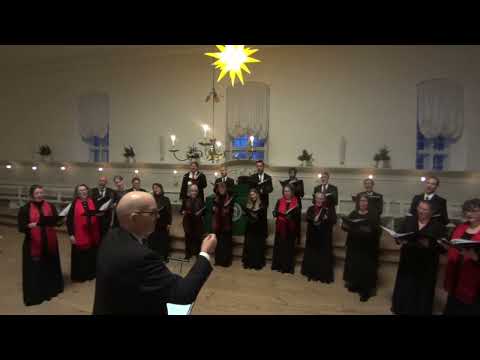
Dejlig er den himmel blå - Coro Misto; arr. by Søren Birch


Dejlig er den himmel blå - DR Pigekoret; arr. by Idunn Vindspoll 


And here is a performance of the English language version . . .

Bright and Glorious is the Sky - Laestadian Lutheran Church


Bright and glorious is the sky,
Radiant are the heavens high
Where the golden stars were shining
And their rays to earth inclining,
Beckoning us to heaven above,
Beckoning us to heaven above.

On that holy Christmas night
Through the darkness beamed a light
All the stars above were paling,
All their luster slowly failing,
As the Christmas star drew nigh,
As the Christmas star drew nigh.

Sages from the East afar,
When they saw this wondrous star,
Went to the find the King of nations,
And to offer their oblations
Unto Him as Lord and King,
Unto Him as Lord and King.

Him they found in Bethlehem,
Yet He wore no diadem;
They but saw a maiden lowly
With an Infant pure and holy,
Resting in her loving arms,
Resting in her loving arms.

Guided by the star they found
Him Whose praise the ages sound,
We too have a star to guide us
Which forever will provide us
With the light to find our Lord,
With the light to find our Lord.

As a star God’s holy Word
Leads us to our King and Lord;
Brightly from its sacred pages
Shall this light throughout the ages
Shine upon our path of life,
Shine upon our path of life.


If you made it this far, have a music filled 2026, and spread the word about these wonderful carols!
Vinny

Monday, January 5, 2026

Twelve Days of Christmas

Day 12Wassail! Wassail! All Over The Town (The Gloucester Wassail)

Through the years there have been many different variations of the lyrics, chorus, and number of stanzas sung for The Gloucester Wassail, depending on the historical time period, geographic location, and individual circumstance. The underlying tune used for the lyrics has also altered considerably, depending on similar factors. However the current version of the tune is documented to have existed for at least several hundred years. The sheet music published in William Henry Husk's Songs of the Nativity (1868), which contains the oldest reference of it being sung (in the 1790s), resembles the modern version, and in the oldest known sheet music publication in the Times Telescope (1813), the tune also resembles the one still sung today. (note from Wikipedia)

Refrain
Wassail! wassail! all over the town,
Our toast it is white and our ale it is brown;
Our bowl it is made of the white (green) maple tree;
With the wassailing bowl, we'll drink to thee.

1. Here's to our horse, and to his right ear,
God send our master a happy new year:
A happy new year as e'er he did see,
With my wassailing bowl I drink to thee.  Refrain

2. So here is to Cherry and to his right cheek
Pray God send our master a good piece of beef
And a good piece of beef that may we all see
With the wassailing bowl, we'll drink to thee.  Refrain

3. Here's to our mare, and to her right eye,
God send our mistress a good Christmas pie;
A good Christmas pie as e'er I did see,
With my wassailing bowl I drink to thee.  Refrain

4. So here is to Broad Mary and to her broad horn
May God send our master a good crop of corn
And a good crop of corn that may we all see
With the wassailing bowl, we'll drink to thee.  Refrain

5. And here is to Fillpail and to her left ear
Pray God send our master a happy New Year
And a happy New Year as e'er he did see
With the wassailing bowl, we'll drink to thee.  Refrain

6. Here's to our cow, and to her long tail,
God send our master us never may fail
Of a cup of good beer: I pray you draw near,
And our jolly wassail it's then you shall hear.

7. Come butler, come fill us a bowl of the best
Then we hope that your soul in heaven may rest
But if you do draw us a bowl of the small
Then down shall go butler, bowl and all.

8. Then here's to the maid in the lily white smock,
Who tripp'd to the door and slipp'd back the lock;
Who tripp'd to the door and pull'd back the pin,
For to let these jolly Wassailers walk in.

9. Be here any maids? I suppose here be some;
Sure they will not let young men stand on the cold stone!
Sing hey O, maids! come trole back the pin,
And the fairest maid in the house let us all in.

10. Here's to Dobbin, and to his right ear,
God send our master a happy New Year;
A happy New Year as e'er he did see
With my Wassailing Bowl I drink to thee.

11. Here's a health to the ox and to his right eye,
Pray God send our master a good Christmas pie,
A good Christmas pie as e'er I did see
In the Wassail bowl we'll drink unto thee

12. Here's a health to the ox and to his right horn,
Pray God send our master a good crop of corn,
A good crop of corn as e'er I did see,
In the Wassail bowl we'll drink unto thee

13. Here's a health to the ox and to his long tail,
Pray God send our master a good cask of ale,
A good cask of ale as e'er I did see,
In the Wassail bowl we'll drink unto thee

14 . . . and many others . . .

Wassail! Wassail! All Over The Town - The Waverly Consort [Refrain, 3, 4, 5, 6, 7, 8, 9]


Wassail! Wassail! All Over The Town - The Longest Johns [Refrain, 2, 10, 7, 8]


Wassail! Wassail! All Over The Town - arr. by Ralph Vaughan Williams [Refrain, 11, 12, 13, 7, 8]


Sunday, January 4, 2026

Twelve Days of Christmas

Day 11In the Ending of the Year

The words for this carol are from the 12th century anonymous German carol In hoc anni circulo (In the Year's Circle). This text was translated by Rev. John Mason Neale and published in his Medieval Hymns (1863).  Neale noted that In hoc anni circulo is "one of the most popular of Christmas Carols, and is found with greater variations than almost any other. There is scarcely a European language which has not had an ancient translation." In 1908 George Radcliffe Woodward reinterpreted Neale's translation and published it in his Songs of Syon. The melody (from the Jistebnicz Kantional, circa 1420) was then harmonized by Woodward for his collection.

The version of In the Ending of the Year we'll hear today, however, is by composer Peter Niedmann, written in 1994 and employing five of Woodward's original ten verses.

1. In the ending of the year
Light and life to man appear:
And the Holy Babe is here,
By the Virgin Mary.
For the Word becometh flesh
By the Virgin Mary.

2. Adam ate the fruit and died,
But the curse, that did betide
All his sons, is turn’d aside 
By the Virgin Mary.
For the Word becometh flesh
By the Virgin Mary.

3. Noah shut the Ark of old,
When the flood came, as is told:
Us its doors to-day enfold 
By the Virgin Mary.
For the Word becometh flesh
By the Virgin Mary.

4. Every creature of the plain
Own’d the guileful serpent’s reign;
He this happy day is slain 
By the Virgin Mary.
For the Word becometh flesh
By the Virgin Mary. 

5. Wherefore let our quire to-day 
Banish sorrow far away, 
Singing and exulting aye 
With the Virgin Mary.
For the Word becometh flesh
By the Virgin Mary.


In the Ending of the Year - Harvard University Choir


Saturday, January 3, 2026

Twelve Day of Christmas

Day 10 - A la venue de Noël

In 17th century France secular noëls (carols) from Provence associated with the miracle of the Nativity were not allowed to be sung during Mass. Composers like Balbastre, Daquin, and Corrette found a way around this ban: they arranged them for the organ. One approach to transcribing these noëls was very inventive and playful: the theme is presented, then varied using specific registers of the organ (oboe, cromorne, flute) to imitate the rustic instruments of shepherds. One such Provençal noël, by composer Nicolas Saboly (1614-1675), is A la venue de Noël (The Arrival of Christmas).

1. A la venue de Noël
   At the coming of Christmas,
Chacun se doit bien réjouir
   Everyone should rejoice,
Car c'est un testament nouvel
   For it is a new covenant
|: Que tout le monde doit tenir. :|
   That everyone must uphold.

2. Quand par son orgueil, Lucifer
   When, through his pride, Lucifer
Dedans l'abîme trébucha
   Stumbled into the abyss,
Nous conduisant tous en enfer
   Leading us all to hell,
|: Le Fils de Dieu nous racheta. :|
   The Son of God redeemed us.

3. Incontinent que Dieu fut né
   As soon as God was born,
L'ange l'alla dire aux pastours
   The angel went to tell the shepherds,
Qui se prirent tous à chanter
   Who all began to sing,
|: Sonnant chevrettes et tambours. :|
   Playing pipes and drums.

4. Après un bien petit de temps
   After a very short time,
Trois rois le vinrent adorer
   Three kings came to adore him,
Portant la myrrhe avec l'encens
   Bringing myrrh and frankincense,
|: Et l'or qui est fort à priser. :|
   And gold, which is highly prized.

5. Là, virent le doux Jésus-Christ
   There, they saw the sweet Jesus Christ,
Et la mère qui le porta
   And the mother who bore him,
Celui qui tout le monde fit
   He who created the whole world,
|: Et les pécheurs ressuscita. :|
   And resurrected sinners.

6. Bien apparut qu'il nous aima
   It was clearly shown that he loved us
Quand à la croix pour nous fut mis
   When he was placed on the cross for us;
Dieu le Père qui tout créa
   God the Father, who created all,
|: Nous donne à la fin Paradis. :|
   Gives us Paradise in the end.

A la venue de Noël


A la venue de Noël - arr. by Christophe Gautier / Maîtrise Notre-Dame de Paris


. . . and an organ variation on A la venue de Noël by Claude Bénigne Balbastre.

A la venue de Noël - Robert Lehman, organ


Thursday, January 1, 2026

Twelve Days of Christmas

Day 9 - Adoração dos pastores (The Adoration of the Shepherds)

The tradition of singing Christmas carols is celebrated in most Christian countries, from the Philippines to Poland, passing through Greece and Ukraine. Even in less cold Christmases, such as in Australia and New Zealand, there is a custom of singing by candlelight on the nights preceding and following December 25th. On the Iberian Peninsula, various cultural differences gave rise to different ways of singing Christmas carols. In Spain, Villancicos, inspired by medieval dances, are popular; in Portugal, the theme is its own; poets like Camões used the form, but applied it to themes that were anything but Christmas related.

The story of The Adoration of the Shepherds (Adoração dos pastores) in Christmas carols harks back to the biblical narrative of the shepherds who were the first to receive the news of Jesus' birth, symbolizing humility, simplicity, and God's acceptance of the marginalized. These events have been transformed into hymns and songs that celebrate this encounter with the Savior, reinforcing the message of love and gratitude.

Um pastor vindo de longe
   A shepherd from afar
À nossa porta bateu
   Knocked at our door
Trouxe recados que dizem
   He brought tidings that say
O Deus menino nasceu.
   The Baby God is born.

Este recado tivemos
   We received this message
Já meia noite seria
   It was already midnight
Estrelas do céu lá vamos
   Stars in the sky, let's go
Dar parabéns a Maria.
   To congratulate Mary.

Vamos ter com os mais pastores
   Let's go with the other shepherds
Não se percam no caminho
   Don't get lost on the way
Vamos todos e depressa
   Let's all go quickly
Visitar o Deus Menino.
   To visit the Baby God.

Ai, que formoso Menino!
   Oh, what a beautiful Child!
Ai, que tanta graça tem!
   Oh, what grace He has!
Ai, que tanto se parece
   Oh, how much He resembles
Com sua Senhora Mãe!
   His Lady Mother!

Adoração dos pastores - arr. Mário Nascimento / Coro Ninfas do Lis (Portugal)


Adoração dos pastore - arr. by Carlos Santos Silva / Coral a cappelas


Adoração dos pastores - Coro Areias de Vilar (Portugal)


Twelve Days of Christmas - New Year’s Day

Day 8 - Some New Year’s Day Songs!

The Shepherd's Carol . . . to be sung on New Year's Day

The New Year is begun,
Good morrow, my masters all!
The cheerful rising sun
Now shining in this hall,
Brings mirth and joy to man and boy
With all that here doth dwell;
Whom Jesus bless with love's increase
So all things shall prosper well.

A New Year's gift I bring
Unto my master here,
Which is a welcome thing
Of mirth and merry cheer.
A New Year's lamb come from thy dam
An hour before daybreak;
Your noted ewe doth this bestow,
Good master, for your sake.

And to my dame so king
This New Year's gift I bring;
I'll bear an honest mind
Unto her while I live.
Your white-wooled sheep I'll safely keep
From harm of brush or briar,
That garments gay for your array
May clothe you the next New Year.

And to your children all,
These New Year's gifts I bring;
And though the price be small,
They're fit for queen or king:
Fair pippins red kept in my bed
A-mellowing since last year,
Whose beauty bright so clear of sight
Their hearts will glad and cheer.

And to your maids and men
I bring both points and pins;
Come bid me welcome then,
The good New Year begins;
Thy office show before I go,
My bottle and bag come fill;
And for thy sake I'll merry make
Upon the next green hill.

The Shepherd's Carol - Passamezzo


Young Men and Maids On New Year's Day . . . a carol for New Year's Day

Young men and maids on New Year's Day,
Their loves they will present
With many a gift both fine and gay,
Which gives them true content:
And though the gift be great or small,
Yet this is the custom still
Expressing their loves in ribbons and gloves,
It being their kind good-will.

Fine ruffs, cravats of curious lace
Maids give them fine and neat;
For this the young men will them embrace
With tender kisses sweet:
And give them many pleasant toys
To deck them fine and gay,
As bodkins and rings with other fine things
For the honour of New Year's day.

Young Men and Maids On New Year's Day - Passamezzo


Twelve Days of Christmas

Epiphany - Bright and Glorious is the Sky The Epiphany , January 6, traditionally marks the end of Christmas and tells the story (from the ...