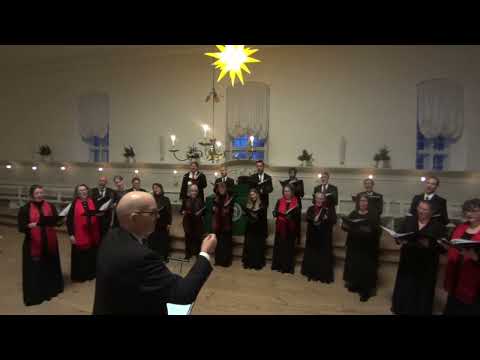
När det lider mot jul, also known as Det strålar en stjärna, is a Swedish Christmas song with lyrics by Jeanna Oterdahl, and written for vocals and piano in 1909 by Ruben Liljefors. A version for mixed choir, a cappella, was arranged in 1933 and originally published in 1944.
Det strålar en stjärna förunderligt blid [There is a star shining wonderfully gentle] I öster på himlen hon står. [In the east in the sky it is] Hon lyst över världenes oro och strid [It has been gleaming over the worries and struggles of the world] I nära två tusende år. [Since nearly two thousand years]
När dagen blir mörk och när snön faller vit, [When the day gets dark and when the snow falls white] Då skrider hon närmre, då kommer hon hit. [It comes closer, then it comes here] Och då vet man, att snart är det jul! [And then you know that soon it is Christmas] for the rest of the English translation, see here Ty julen är härlig för stora och små, Är glädje och ljuvaste frid. Är klappar och julgran och ringdans också, Är lycka oändligen blid
Är ljus, allas ögon då stråla som bäst Och stjärnorna tindra som mest. Och där ljuset är, där är det jul!
När dagen blir mörk och när snön faller vit, Då skrider hon närmre, då kommer hon hit. Och då vet man, att snart är det jul!
Vamos, Pastores, Vamos is a song for the Christmas season composed in 16th century Spain. The traditional melody accompanies lyrics that invite the shepherds to visit the newborn Jesus and to be witnesses of His glory. It has long been one of the most widely recognized and sung Christmas Carols in the Latin America.
Chorus: Vamos pastores, vamos (Come, shepherds, come) Vamos a Belén (Let's go to Bethlehem) A ver en ese niño (To see in that Child) La gloria del Edén (The glory of Eden) A ver en ese niño (To see in that Child) La gloria del Edén (The glory of Eden)
¡Ese precioso niño! (That precious Boy!) Yo me muero por Él (I am dying for Him) Sus ojitos me encantan (I love his little eyes) Su boquita también (His mouth too) El padre le acaricia (The father caresses Him) La madre mira en Él (The mother looks at Him) Y los dos extasiados (And the two ecstatic) Contemplan aquel ser (They contemplate that being) Contemplan aquel ser (They contemplate that being)
CHORUS
Es tan lindo el chiquito (The Little One is so cute) Que nunca podrá ser (It is unbelievable) Que su belleza copie (Let her beauty be copied) El lápiz y el pincel (Pencil and brush) Pues el Eterno Padre (By the Eternal Father) Con inmenso poder (With immense power) Hizo que el Hijo fuera (He made the Son be) Excelso como Él (Exalted like Him) Excelso como Él (Exalted like Him)
CHORUS
Vamos, Pastores, Vamos - Estudiantina Guadalajara
Vamos, Pastores, Vamos - Eastern Bloom
Vamos, Pastores, Vamos - Cantos de Misa con Ukelele
Although we know the music and lyrics of Tu scendi dalle stelle were written by the Neapolitan bishop, spiritual writer, composer, musician, artist, poet, lawyer, scholastic philosopher, and theologian Alphonsus Liguori, it’s not common knowledge that today’s carol was inspired by the Neapolitan folksong Quanno nascette Ninno a Bettlemme (When the baby was born in Bethlehem) - sometimes referred to as the Carol of the Bagpipers (Canzone d'i zampognari) - and that Alphonsus was the first priest to write lyrics for a religious song in dialect. Some scholars believe that Alphonsus, a gifted musician, wrote the music and lyrics (in dialect) while staying at the Convent of the Consolation in Deliceto, a town in the province of Foggia, and that only later did Pope Pius IX translate Alphonsus’ lyrics into Italian. Others think that Alphonsus wrote two versions, one with lyrics in dialect and one with lyrics in Italian, at the same time.
Tu scendi dalle stelle has seven verses. Its lyrics, however, are far from joyous, much less concerned with the joy of Baby Jesus’ birth than with the heart-rending sacrifice of his death to save mankind.
Tu scendi dalle stelle o Re del Cielo [You come down from the stars, Oh, King of Heavens] E vieni in una grotta al freddo al gelo. [And You come in a cave in the cold, in the frost] O Bambino mio Divino [Oh, my Divine Baby] Io ti vedo qui a tremar, [I see you trembling here] O Dio Beato! [Oh, Blessed God] Ah, quanto ti costò l'avermi amato. [Ah, how much it costs You, your loving me]
You can find the rest of the English translation here
A te che sei del mondo, il Creatore, Mancano panni e fuoco, o mio Signore. Caro eletto pargoletto, Quanto questa povertà Più mi innamora, Giacchè ti fece amor povero ancora.
Tu lasci il bel gioir del divin seno, per giunger a penar su poco fieno. Dolce amore del mio core, dove amore Ti trasportò? O Gesù mio, Perché tanto patir? Per amor mio!
Ma se fu Tuo volere il Tuo patire, Perché vuoi pianger poi, perché vagire? Mio Gesù, T'intendo sì! Ah, mio Signore! Tu piangi non per duol, ma per amore.
Tu piangi per vederti da me ingrato dove sì grande amor, sì poco amato! O diletto del mio petto, Se già un tempo fu così, or Te sol bramo. caro non pianger più, ch'io T'amo e T'amo.
Tu dormi, Ninno mio, ma intanto il core non dorme, no, ma veglia a tutte l'ore. Deh, mio bello e puro Agnello a che pensi? Dimmi tu. O amore immenso! "Un dì morir per Te", rispondi, "io penso".
Dunque a morire per me, Tu pensi, o Dio: e chi altro, fuor di Te, amar poss'io? O Maria, speranza mia, se poc'amo il Tuo Gesù, non Ti sdegnare. Amalo tu per me, s'io nol so amare!
Tu scendi dalle stelle - Coro dei Fiorentini
Tu scendi dalle stelle - Luciano Pavarotti
Tu scendi dalle stelle - Zampognari (bagpipers) on a street in Italy
Tu scendi dalle stelle - a more upbeat version by Coro Montepilar
Quanno nascette Nínno a Bettlemme - Piccolo Coro dell' Antoniano
Quanno nascette Nínno a Bettlemme - Beasley & Accordone
Noël Nouvelet is a traditional French Christmas and New Year's carol. The carol dates from the late 15th or early 16th century, and there are at least 13 verses available to sing. The word nouvelet has the same root as Noël, both stemming from the word for news and newness. The song was long ago translated into English as Sing We Now of Christmas, though the English lyrics (usually 5 verses) are somewhat different from the original French ones.
Some sources say it was a song celebrating the New Year. Others point out that the lyrics mainly speak of the news of the birth of the Christ Child in Bethlehem, the announcement by angels to the shepherds in the fields, looking forward to the visit of the Three Kings and the presentation of their gifts to the Holy Family. The carol also celebrates the figures in the crèche, the handmade nativity scenes found throughout France, where they are part of the Christmas celebration in homes and in town squares. And at the time it was written it was sung by families at home and at community gatherings, rather than as part of the liturgy in Roman Catholic churches. [thanks to the folks at ThoughtCo.com]
Noël nouvelet, Noël chantons ici, [New Christmas, Christmas we sing here] - literal English translation Dévotes gens, crions à Dieu merci! [Devout people, let us shout our thanks to God!
Chorus : Chantons Noël pour le Roi nouvelet! [Let us sing Christmas for the new King!] Chantons Noël pour le Roi nouvelet! Noël nouvelet, Noël chantons ici! [New Christmas, Christmas we sing here.
Quand je m’éveillai, et j’eus assez dormi, [When I awoke, and had enough sleep] Ouvris les yeux, vis un arbre fleuri, [Open your eyes, see a flowering tree] Dont il sortait un bouton vermeillet. [From which a ruddy button came out] Noël nouvelet, Noël chantons ici. [Christmas new, Christmas singing here]
D’un oyselet après le chant oui, [An angel after hearing the songs] Qui aux pasteurs disait: 'Partez d’ici [Said to the shepherds: “Leave here] En Bethléem trouvèrent l’agnelet [in Bethlehem you’ll find the little lamb] Noël nouvelet, Noël chantons ici. [Christmas new, Christmas singing here]
~ ~ ~ ~ ~ ~ ~ ~
Sing we now of Christmas, Noel, sing we here! Hear our grateful praises to the babe so dear.
Refrain: Sing we Noel, the King is born, Noel! Sing we now of Christmas, sing we now Noel!
Angels called to shepherds, "Leave your flocks at rest, journey forth to Bethlehem, find the lambkin blest." [Refrain]
In Bethlehem they found him; Joseph and Mary mild, seated by the manger, watching the holy child. [Refrain]
From the eastern country came the kings afar, bearing gifts to Bethlehem guided by a star. [Refrain]
Gold and myrrh they took there, gifts of greatest price; there was ne'er a place on earth so like paradise. [Refrain]
Noël nouvelet - ANÚNA
Noël nouvelet - The King's Singers
Noël nouvelet - Apollo's Fire
And here's a baroque interpretation of Noël nouvelet by composer Edwin McLean
Day 11 - Lulajże, Jezuniu (Lullaby, Little Baby Jesus) [Poland]
Setting a more contemplative mood than yesterday's carols is the beautiful and well loved Polish carol Lulajże, Jezuniu (Lullaby, Little Baby Jesus/Sleep, Jesus). A traditional carol (author and composer unknown), this Koleda (Polish for "carol") is frequently sung in church at a special moment during midnight mass on Christmas Eve. The first written sources in which the words Lulajże, Jezuniu were found come from the beginning of the 18th century. It was first published in 1767 in Father Michał Marcin Mioduszewski's Kantyczki (Canticles) - hymns or chants, typically with a biblical text, forming a regular part of a church service. Later, in 1843, it was also included in Pastorals and Christmas Carols, songs for Christmas to be sung around the house. Lulajże, Jezuniu is a typical lullaby not only because of its delicate, romantic melody, but also because the text is full of maternal tenderness and caring. A pearl, a flower, a rose, an angel - these are just some of the caressing terms used to address the Child falling asleep in a manger. The carol - although devoid of biblical details and theological wisdom - conveys the extraordinary truth about Mary's love for her newborn Son and the beauty of her divine motherhood.
Lulajze, Jezuniu, moja perelko, Lulaj, ulubione me piescidelko. Lulajze, Jezuniu, lulajze, lulaj! A ty Go, Matulu, w placzu utulaj. Zamknijze znuzone placzem powieczki, Utulze zemdlone lkaniem usteczki. Lulajze, Jezuniu, lulajze lulaj! A ty Go, Matulu, w placzu utulaj.
Lulajze, piekniuchny nasz Anioleczku, Lulajze, wdzieczniuchny swiata Kwiateczku. Lulajze, Jezuniu, lulajze lulaj! A ty Go, Matulu, w placzu utulaj.
Lulajze, Rzyczko najozdobniejsza, Lulajze, Lilijko najprzyjemniejsza. Lulajze, Jezuniu, lulajze lulaj! A ty Go, Matulu, w placzu utulaj.
Lulajze, przyjemna oczom Gwiazdeczko, Lulaj, najsliczniejsze swiata Sloneczko. Lulajze, Jezuniu, lulajze lulaj! A ty Go, Matulu, w placzu utulaj.
Lullaby, little baby Jesus, my little pearl, Lull, my favorite little cuddley one.
Lullaby, little baby Jesus, lullaby, lull, And you, the mama, calm him down when crying.
Close your little eyelids, weary from weeping, Relax your little lips, tired from sobbing.
Lullaby, little baby Jesus, lullaby, lull, And you, the mama, calm him down when crying.
Lullaby, our most lovely little angel, Lullaby, the most enchanting little flower in the world.
Lullaby, little baby Jesus, lullaby, lull, And you, the mama, calm him down when crying.
Lullaby, the most gorgeous little rose, Lullaby, the most pleasant little lily.
Lullaby, little baby Jesus, lullaby, lull, And you, the mama, calm him down when crying.
Lullaby, lovely little star delighting our eyes, Lullaby, the most beautiful little sun in the world.
Lullaby, little baby Jesus, lullaby, lull, And you, the mama, calm him down when crying.
Hush, hush, hush, everyone get ready for bed, Don't wake up my little baby.
Lullaby, little baby Jesus, lullaby, lull, And you, the mama, calm him down when crying.
Lulajże, Jezuniu (Lullaby, Little Baby Jesus) - Skowronki Girls' Choir
Day 12 - Another year, another Holiday season, another Twelve Days of Christmas - Before and After! I hope you've made it through this chaotic year as best you could, and that you've been able to contemplate - and perhaps even DO - some of the familiar holiday activities that bring us all comfort and joy.
The first of our Twelve Days contains two carols - one from Germany, written by a known poet and a known composer, and the second from Bohemia (part of the present day Czech Republic), a traditional carol with no known creator. And the funny part about it all, from my personal perspective, is that I thought they were the same carol! And they ARE very similar in sound and structure. Even their German names are very similar, at least from a non German-speaking American's point of view!
So let's delve into Ihr Kinderlein, kommet (O, Come, Little Children) and after that, Kommet, ihr Hirten (Come, Ye Shepherds).
First, Ihr Kinderlein, kommet (O, Come, Little Children). The poetic text was written around 1798 by Christoph von Schmid, with the title Die Kinder bei der Krippe (The Children at the Manger). The original poem had eight verses and it was published in 1811. Schmid then included it in his 1818 collection Blüten dem blühenden Alter gewidmet (Flowers dedicated to the flowering age). Together with other poems from this collection, it was set to music in 1837 by Franz Xaver Luft. However, the music which today is associated with Ihr Kinderlein, kommet was written by composer Johann Abraham Peter Schulz. It originally appeared in 1794 as a secular song named Wie reizend, wie wonnig (How charming, how pleasant). Around 1832, Schulz's melody was combined with Schmid's poem for the collection Sechzig deutsche Lieder für dreißig Pfennig (Sixty German Songs for Thirty Pennies). In addition to its popularity as a Christmas carol, the song has become known around the world as one of the first pieces that children learn when studying the violin using the Suzuki method.
Off we go . . .
Ihr Kinderlein, kommet, o kommet doch all! Zur Krippe her kommet in Bethlehems Stall und seht, was in dieser hochheiligen Nacht der Vater im Himmel für Freude uns macht! [the full German text is . . . here]
Oh, come, little children, oh, come, one and all, To Bethlehem's stable, in Bethlehem's stall. And see with rejoicing this glorious sight, Our Father in heaven has sent us this night.
Oh, see in the manger, in hallowèd light A star throws its beam on this holiest sight. In clean swaddling clothes lies the heavenly Child, More lovely than angels, this Baby so mild.
Oh, there lies the Christ Child, on hay and on straw; The shepherds are kneeling before Him with awe. And Mary and Joseph smile on Him with love, While angels are singing sweet songs from above.
English translation by Melanie Schulte (1885–1922)
Ihr Kinderlein, kommet - Dresdner Kreuzchor
Our second tune, Nesem vám noviny (in German: Kommet, ihr Hirten; in English: Come, Ye Shepherds) is a traditional Bohemian carol, later translated into German and eventually into English. The German text was written as a free translation from the Czech original by Carl Riedel and first published in 1870 under the title Die Engel und die Hirten (The Angels and the Shepherds). The English version, translated by Mari Ruef Hofer as Come, All Ye Shepherds, was published in 1912.
Nesem vám noviny, poslouchejte Z betlémské krajiny, pozor dejte Slyšte je pilně a neomylně Slyšte je pilně a neomylně Rozjímejte
Kommet, ihr Hirten, ihr Männer und Fraun, Kommet, das liebliche Kindlein zu schaun, Christus, der Herr, ist heute geboren, Den Gott zum Heiland euch hat erkoren. Fürchtet euch nicht!
Come now, ye shepherds, away from your fold, Come, the dear lovable Child to behold; Gaze with delight on Christ, the Anointed, By God as Savior for us appointed, Banish all fear!
Yea, let us witness in Bethlehem's stall What we have heard through the heavenly call; There, with glad voices, publish the story, Sing of the Savior's wonderful glory. Hallelujah!
Truly the angels are singing to-day Unto the shepherds this beautiful lay: Peace in its fullness to you is granted, Good will to mortals in all hearts planted. Glory to God!
Nesem vám noviny - Balthasar-Neumann-Chor
Nesem vám noviny - Church of the Holy Family
Both carols appear on YouTube in many different performances. I feel that both carols sound best at a more up-tempo speed. I hope these two lovely, catchy, and boisterous carols will lift our spirits and sweep us into the 2021 Holiday Season - Enjoy!
It's been quite a while since I posted anything; I've been busy getting the PCO up and running again. A great big thanks to everyone who's been able to come out and start playing together again!
I have also been doing some research on the English Madrigalist composers, who flourished at the end of the 16th and beginning of the 17th century. The most famous names among these composers are William Byrd and Thomas Morley (with his ever popular Now is the Month of Maying). One of the lesser known madrigalists is John Bennet, and it is his music that I've been listening to and arranging.
Not much is known about Bennet's life. He was born sometime around 1575, and died sometime after 1614. Despite this dearth of information and his rather meager legacy of compositions, since one of his pieces was published in the collection The Triumphs of Oriana (1601) - which included music by 22 other madrigalists - Bennet's high standing among the leading composers of the time is fairly certain.
One of Bennet's most famous pieces is Weep, O mine eyes, a madrigal for four voices. It is based on/inspired by the even more famous Flow, my teares, a lute song by John Dowland (1563–1626).
I couldn't help sharing this beautiful music. Sad music for sad times. Let us remember those no longer with us, and look forward to better days ahead.
John Bennet: Weep, O mine eyes - performed by Ensemble Luau
Weep, O mine eyes and cease not, alas, these your spring tides methinks increase not. O when begin you to swell so high that I may drown me in you?
John Dowland: Flow my teares - performed by Valeria Mignaco (soprano) & Alfonso Marin (lute)
Flow, my tears, fall from your springs! Exiled for ever, let me mourn; Where night's black bird her sad infamy sings, There let me live forlorn.
Down vain lights, shine you no more! No nights are dark enough for those That in despair their lost fortunes deplore. Light doth but shame disclose.
Never may my woes be relieved, Since pity is fled; And tears and sighs and groans my weary days Of all joys have deprived.
From the highest spire of contentment My fortune is thrown; And fear and grief and pain for my deserts Are my hopes, since hope is gone.
Hark! you shadows that in darkness dwell, Learn to condemn light Happy, happy they that in hell Feel not the world's despite.
John Dowland: Lachrimae Antiquae Pavan (an instrumental version of Flow my teares) - performed by Finnish Rso
Toward the end of World War I, when many French theaters and concert venues were shuttered due to the ongoing global conflict, visionaries of the modern art movement began to put on small concerts in spaces that were readily available to them - their own art studios. One such event that took place in 1917 featured a space with walls decorated by paintings of Picasso, Matisse, Léger, Modigliani and others; the music presented was by Erik Satie, George Auric, Louis Durey and Arthur Honegger. Over the next few years a number of these composers banded together (somewhat by chance) to form Les Six; six composers whose common purpose was to write music reacting against the musical styles of both the Germanic Richard Wagner and the Impressionist Claude Debussy.
Les Six (from oldest to youngest) consisted of Louis Durey, Arthur Honegger, Germaine Tailleferre, Darius Milhaud, Francis Poulenc, and Georges Auric. All were French, except for Honegger, who was born in France to Swiss parents. From the moment their names were joined together, these disparate and unique composers forged paths all their own, some writing works that spoke not only to their own time, but that continue to speak to us over a century later.
One of Arthur Honegger's most famous works, Pacific 231, written in 1923, depicts, through sound, the impressive machinations of a steam locomotive. An avid train enthusiast himself, he once mused: "I have always loved locomotives passionately. For me they are living creatures and I love them as others love women or horses." But it is not the machine age that we visit today, but a beautiful depiction of Honegger's beloved Swiss alps. Inspired by a vacation to Bern in 1920 he composed Pastorale d'été(Summer Pastorale). On the score itself is inscribed an epigraph by Arthur Rimbaud: J'ai embrassé l'aube d'été - I have embraced the summer dawn. The music speaks for itself . . . Enjoy!
One of my favorite composer from the past 450 years(!) is Anthony Holborne, who was born sometime around 1562 and died 29 November, 1602. Not much is actually known about his life. One detail is that he was one of the composers in the service of England's Queen Elizabeth I (1533-1603). The music that has come down to us was written for lute, cittern (a guitar/mandolin like instrument), chittara (similar to the modern acoustic guitar) and instrumental consort. Holborne sometimes arranged his lute/chittara/cittern pieces for a consort of viola da gambas or strings and winds. And lastly, his works consist mainly of Pavans, Galliards, Almains, Airs, and Fantasias, the slower works exuding a melancholy that was highly prized in the English court of the time.
Here are some of my favorite Holborne works:
Muy Linda (Very Pretty) - performed by L'Achéron
. . . and the same piece performed by lutenist Michal Gondko
The Night Watch - performed by the Chelys Consort
Countess Of Pembrokes' Paradise - Noam Kanter (guitar) . . . by the way, Holborne's patron was the Countess of Pembroke, Mary Sidney
The titles of some of Holborne's pieces seem to refer to literary works of the day. In Edmund Spenser's The Shepheardes Calendar (1579), the shepherds, Perigot and Willye meet and decide to have a singing match (a rustic game immortalized in the Idylls of Theocritus). Each shepherd sings a line, answered by the other. One begins 'As it fell on a holie eve', and the other replies 'Heigh Ho Holiday' and so their contest proceeds . . .
Heigh Ho Holiday - performed by ViolMedium
. . . and the same piece performed by lutenist Julian Bream
Two of the courtly dances of Holborne's time were the Pavane and the Gailliard. The word pavane most probably comes from "padovana" (old Italian: "from Padua"), though it's origin might also derive from the Spanish word "pavón" meaning peacock. This courtly dance, almost certainly of Italian origin, is often associated with Spain, and the decorous sweep of the pavane very much suited the new more sober Spanish-influenced courtly manners of 16th-century Italy. The Pavane is often joined to a second, faster Gailliard. The galliard was a favorite dance of Queen Elizabeth I of England, and although it is a relatively vigorous dance, in 1589 when the Queen was in her mid-fifties, John Stanhope of the Privy Chamber reported, "the Queen is so well as I assure you, six or seven galliards in a morning, besides music and singing, is her ordinary exercise."
Pavan and Galliard - performed by Thomas C. Boysen (lute)
. . . and here's a demonstration of royalty dancing a Pavane and Galliard
And lastly (if you've made it this far!) one of my all-time favorites - The Fairie Round
The Fairie Round - John Bigelow (lute)
The Fairie Round - performed by The Voices of Music
The Fairie Round - performed by Hespèrion XXI , Jordi Savall director
We'll take a little leap today and find ourselves in some very unique and fascinating sound worlds, with three short pieces by John Cage, Delia Derbyshire, and Igor Stravinsky.
During the years 1946, 1947 and 1948 John Cage composed his Sonatas and Interludes for Prepared Piano, a cycle of twenty pieces to be performed on a piano "prepared" with various alterations to the strings and soundboard. These alterations create a sound world far removed from the one we normally expect to hear from a standard grand piano. Cage composed these works shortly after his introduction to two of the major influences that would change his approach to musical composition - Indian philosophy and the teachings of art historian Ananda K. Coomaraswamy.
At the beginning of 1946, Cage met Gita Sarabhai, an Indian musician who came to the United States concerned about Western influence on the music of her country. She ended up studying with Cage, who offered to teach her for free if she taught him about Indian music in return. The purpose of music, according to Sarabhai's teacher in India, was "to sober and quiet the mind, thus rendering it susceptible to divine influences", and this definition became one of the cornerstones of Cage's view on music and art in general. And it is this that he began to explore in his Sonatas and Interludes.
Here's a fantastic video performance of the Sonata No. 5 performed by pianist Carlos Sanchis Aguirre.
I couldn't resist this equally amazing performance by David Greilsamm!
Delia Derbyshire was an inspired and innovative composer of electronic music. For a large part of her career - from 1960 to 1973 - she worked in the BBC's Radiophonic Workshop, experimenting and manipulating sound, magnetic tape and recording equipment. To the world at large she is best remembered for arranging and producing the theme music for the Doctor Who series. Her amazingly creative, experimental and groundbreaking work produced sound worlds that express a unique and forward looking vision, stretching the boundaries of what we consider music to be. Derbyshire's haunting and mesmerising Blue Veils and Golden Sands (1967) was composed for the film The World About Us, a documentary about the Tuareg people of the Sahara desert.
For those interested in finding out more about Delia Derbyshire, there's a fine documentary film called The Delian Mode. You can watch it here
And we'll end with the melancholy and meditative first movement of Igor Stravinsky's Three Pieces for Solo Clarinet (1918) performed by Dimitri Schenker.
. . . all Three Pieces (performed by Szymon Parulski) here
While musical styles from various parts of the world intermingled in the early twentieth century, Heitor Villa-Lobos sought to promote Brazilian music throughout the classical music world. Instead of presenting only Brazilian styles, Villa-Lobos, in an attempt to showcase the international adaptability of Brazil's musical culture, developed a style all his own, which was a combination of his classical training in the western tradition and his first-hand experience with both Brazilian popular and Native Brazilian music. Much of his music manifests these influences, but his music for solo guitar, Brazil's national instrument, also features new techniques and timbres used in his Cinq Preludes for solo guitar. - Heather Joy, from her Villa-Lobos’s Cinq Preludes: An Analysis of Influences
Enjoy this beautiful performance of the Villa-Lobos Prelude No. 1 played by guitarist Marcin Dylla
And from Hungary . . . Béla Bartók's Romanian Folk Dances for String Orchestra played by the Norwegian Chamber Orchestra (get out your dancing shoes!)