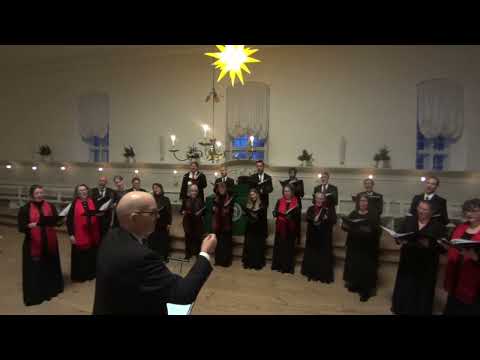
Lucy Walker (b. 1998) is quickly establishing her place as one of Britain’s foremost emerging compositional voices. Her vibrant choral writing has been described as "full of light and beautifully crafted." Walker is passionate about making music - especially choral music - accessible and inclusive, and her compositions and her work teaching other upcoming musicians reflects this mission. Walker’s setting of There is no rose flows between swells of emotion and warm chromatic inflections in the Latin refrains. The piece captures the natural emphases of the anonymous 15th century text, seamlessly moving between irregular and simple time signatures. (from Oxford University Press)
Christmas Day - The Virgin’s Slumber Song (Max Reger)
Some songs written especially for Christmas become so well known that they eventually are thought of as folk songs. The Virgin’s Slumber Song (Maria Wiegenlied) is an example of just the opposite turn of events. Originally a folk-song melody to the words Joseph Dearest, Joseph Mild, this graceful air was taken by the German composer Max Reger and transformed in 1912 into an art song, Maria Wiegenlied. Edward Teschemacher supplied an English translation of this lovely song, which echoes part of Joseph Dearest, Joseph Mild: the Virgin Mary singing to her Baby while He sleeps. The rhythm of both melody and accompaniment suggests the cradle gently rocking. (notes from William L. Simon, Reader’s Digest Merry Christmas Songbook)
Maria sitzt im Rosenhag
Dear Mary sits in rosy bow'r
Und wiegt ihr Jesuskind
And rocks the Jesus child
Durch die Blätter leise
Softly through the golden leaves
Weht der warme Sommerwind
Drifts a breezes so gentle and mild.
Zu ihren Füßen
At her feet
Singt ein buntes Vögelein
Sings a bird all gold and bright
Schlaf, Kindlein, süße
Sleep, dear One, sweet, sweet one
Schlaf nun ein!
Sleep good night!
Hold ist dein Lächeln
Lovely is your gentle smile
Holder deines Schlummers Lust
Telling of your slumber blessed
Leg dein müdes Köpfchen
Lay your tired head so close
Fest an deiner Mutter Brust!
Lay it on your mother's breast!
Schlaf, Kindlein, süße
Sleep, dear One, sweet, sweet one
Schlaf nun ein!
Sleep good night!
The Virgin’s Slumber Song - Sissel Kyrkjebø, soprano
The Appalachian carol Jesus, Jesus, Rest Your Head was collected John Jacob Niles in Hardin County, central Kentucky in the early 20th century. Like so many other folk carols and hymns, the song’s origins predate by many decades its collection and publication. This gentle lullaby is sometimes titled alternatively The Manger Cradle Song, as the lyrics of the refrain take the form a soothing serenade to the sleeping Christ Child on that first Christmas night. (notes thanks to PBS)
Refrain
Jesus, Jesus, rest your head.
You has got a manger bed.
All the evil folk on earth
Sleep in feathers at their birth.
Jesus, Jesus, rest your head.
You has got a manger bed.
Have you heard about our Jesus?
Have you heard about his fate?
How his mammy went to the stable
On that Christmas Eve so late?
Winds were blowing, cows were lowing,
Stars were glowing, glowing, glowing. Refrain
To the manger came the Wise Men.
Bringing gifts from hin and yon,
For the mother and the father,
And the blessed little Son.
Milkmaids left their fields and flocks
And sat beside the ass and ox. Refrain
Jesus, Jesus Rest Your Head - John Jacob Niles, voice & dulcimer
Jesus, Jesus Rest Your Head - Seraphic Fire (arr. by Patrick Dupré Quigley)
Jesus, Jesus Rest Your Head - The Westminster Choir
Jesus, Jesus Rest Your Head - Worcester Cathedral Choir (arr. by A. Warrell)
Day 2 - Don Oíche Ud i mBeithil (That Night in Bethlehem)
There are few Irish Christmas songs as beloved and evocative as Don Oíche Úd i mBeithil - a hauntingly beautiful carol that captures both the tenderness and mystery of Christmas Eve. The song tells the story of Christ’s birth through the lyrical beauty of the Irish language. The origins of Don Oíche Úd i mBeithil are somewhat mysterious. While many assume it is an ancient carol, the earliest known written versions date from the 17th or 18th century. However, its style and phrasing suggest it may have originated as part of Ireland’s oral folk tradition, passed down through generations of singers and storytellers before being written down. It is a staple of Irish Christmas celebrations, sung at midnight Mass, school concerts, and carol services throughout the country. More about the song . . . here
Don oíche úd i mBeithil / I sing of a night in Bethlehem
beidh tagairt faoi ghréin go brách / A night as bright as dawn
Don oíche úd i mBeithil / I sing of that night in Bethlehem
gur tháinig an Briathar slán / The night the Word was born
Tá gríosghrua ar spéartha / The skies are glowing gaily
's an talamh 'na chlúdach bán / The earth in white is dressed
Féach Íosagán sa chléibhín / See Jesus in the cradle
's an Mhaighdean 'Á dhiúl le grá / Drink deep in His mother's breast
Ar leacain lom an tsléibhe / And there on a lonely hillside
go nglacann na haoirí scáth / The shepherds bow down in fear
Nuair in oscailt gheal na spéire / When the heavens open brightly
tá teachtaire Dé ar fáil / And God's message rings out so clear
Céad glóir anois don Athair / Glory now to the Father
sa bhFlaitheasa thuas go hard / In all the heavens high
Is feasta fós ar sa thalamh / And peace to His friends on earth below
d'fheara dea-mhéin' siocháin / Is all the angels cry
The text for this carol derives from Joseph, lieber Joseph mein, a verse from fourteenth or fifteenth century Germany. One of the earliest appearances of Joseph Dearest, Joseph Mild was as a lullaby sung by the Virgin Mary in a Mystery Play that flourished around Leipzig, Germany, in the early 1500s. The borrowed tune used was originally sung to a Latin text full of joy, Resonet in Laudibus (Let Our Praises Resound), dating from as early as the 14th century. Before that time, carols and other religious songs were danced and sung to primitive tunes and graceless texts. But a new awareness of beauty in worship swept through Europe in the 1500s, thanks in part to the Reformation, and melodies took on an ingratiating texture, while beautiful and evocative texts issued from the pens of genius poets. (notes from William L. Simon, Reader’s Digest Merry Christmas Songbook, 1981)
"Joseph, Dearest Joseph mine,
Help me cradle the Child divine.
God reward thee and all that’s thine,
In paradise," so prays the mother Mary.
Chorus
He came among us at Christmas time
At Christmas time in Bethlehem
Men shall bring him from far and wide,
Love’s diadem - Jesus, Jesus;
Lo, he comes and loves and saves and frees us.
"Gladly dear one, Lady mine
Help I cradle this Child of thine."
"God’s own light on us both shall shine,
In paradise," as prays the mother Mary. Chorus
Peace to all that have goodwill!
God, who heaven and earth doth fill,
Comes to turn us away from ill,
And lies so still within the crib of Mary. Chorus
Resonet in laudibus - Aurora Camerata
Resonet in laudibus cum iucundis plausibus
Let praises ring out and joyful acclaim
Sion cum fidelibus: Apparuit quem genuit Maria.
To Zion's faithful the Child born of Mary has appeared.
Gaudete, gaudate, Christus Natur hodie!
Rejoice, rejoice, Christ is born!
Gaudete, gaudate, ex Maria Virgine.
Rejoice, rejoice, from the Virgin Mary.
Pueri concinite, nato regi psallite,
Let us sing together to the child,
Let us sing to the newborn King
Voce pia dicite, Apparuit quem genuit Maria.
and with the pious ones say:
The Child born of Mary has appeared.
Gaudete, gaudate . . .
Sion lauda Dominum Saluatorem omnium,
O Zion, praise the Lord, the Savior of mankind,
Virgo parit Filium. Apparuit quem genuit Maria.
He who cleanses sin.
The Child born of Mary has appeared.
Gaudete, gaudate . . .
Sancta tibi Trinitas, Os omnium gratias
Give thanks to the holy trinity
Let our voices give thanks
Resonet altissimas. Apparuit quem genuit Maria.
And give the greatest praise.
The Child born of Mary has appeared.
Gaudete, gaudate . . .
Joseph Dearest, Joseph Mild - The Westminster Choir
Joseph Dearest, Joseph Mild - The Dale Warland Singers
This song originally hails from a 12th century Latin song Orientis Partibus which first appeared in France and is usually attributed to Pierre de Corbeil, Bishop of Sens (died 1222). The tune is said to have been part of the Fete de l’Ane (The Donkey’s Festival), which celebrated the flight of the Holy Family into Egypt and was a regular Christmas observance in Beauvais and Sens, France in the 13th century. During the mass, it was common for a donkey to be led or ridden into the church. The words and tune were designed to give thanks for the ass on which Mary rode. Each verse was sung, and finished with the chorus "Hail, Sir donkey, hail." It was a solemn affair, but the tune became very popular in 17th and 18th century Germany.
Orientis partibus adventavit asinus
From eastern parts a donkey came
pulcher et fortissimus, Sarcinis aptissimus
Beautifu and strong, fit for loads
Hez, Sir Asnes, hez! / Hey, Sir Donkey, hey!
Saltu vincit hinnulos damas et capreolos
He leaps over young males and bucks
super dromedarios velox madianeos
Over the swift dromedaries of Midian
Hic in collibus Sychen iam nutritus sub Ruben
Here on the hills of Sychen, brought up under Ruben
transiit per Jordanem saliit in Bethlehem
He has crossed the Jordan and leapt into Bethlehem
Dum trahit vehicula multa cum sarcinula
While he draws fully loaded carts
illius mandibula dura terit pabula
His jaw grinds surely grinds the fodder
Cum aristis, hordeum comedit et carduum
With ears he eats barley and thistles
triticum ex palea segregat in area
He separates wheat from chaff on the threshing floor
Amen dicas, asine Iam satur ex gramine
Amen, you donkey now full with grass
amen, amen itera aspernare vetera
Amen, amen repeat the ancient aspersions
The song emigrated to England in the 12th century, where it began to take on its modern character. It is for this reason that some sources will give the origin of this song as England. The tune has been arranged in both 4/4 time (by Richard Redhead) and 3/4 time (Ralph Vaughan Williams). Robert Davis (1881-1950) apparently wrote the words that we normally associate with this tune in the 1920s. The first publication was in 1934. The Friendly Beasts is also known by the titles The Song of the Ass, or The Donkey Carol, or The Animal Carol and The Gift of the Animals. (a big thank you! to the Hymns and Carols of Christmas for all these detailed notes)
Jesus our brother, kind and good
Was humbly born in a stable rude
And the friendly beasts around Him stood,
Jesus our brother, kind and good.
"I," said the donkey, shaggy and brown,
"I carried His mother up hill and down;
I carried her safely to Bethlehem town."
"I," said the donkey, shaggy and brown.
"I," said the cow all white and red
"I gave Him my manger for His bed;
I gave him my hay to pillow his head."
"I," said the cow all white and red.
"I," said the sheep with curly horn,
"I gave Him my wool for His blanket warm;
He wore my coat on Christmas morn."
"I," said the sheep with curly horn.
"I," said the dove from the rafters high,
"I cooed Him to sleep so He would not cry;
We cooed him to sleep, my mate and I."
"I," said the dove from the rafters high.
Thus every beast by some good spell,
In the stable dark was glad to tell
Of the gift he gave Immanuel,
The gift he gave Immanuel.
"I," was glad to tell
Of the gift he gave Immanuel,
The gift he gave Immanuel.
Jesus our brother, kind and good.
Orientis Partibus - New London Consort
The Friendly Beasts - St. Olaf Choir (arr. by R. Scholz)
The Friendly Beasts - Vocal Essence Ensemble (Robert Farlee, composer)
The Friendly Beasts - Burl Ives
The Friendly Beasts - BlindPigAndTheAcorn (Paul and Pap)
Blessed Be That Maid Marie is an old English Christmas carol hailing the birth of Christ. The singers bless the Virgin, rejoicing that after thousands of years the day of Jesus' birth has finally arrived. This hymn is believed to have originated as early as the 15th century and is of unknown authorship. It employs both old English and Latin texts. Blessed Be That Maid Marie has also appeared with the titles Blyssid Be Yt Mayde Mary and Blyssid be that mayde Mary. The music derives from William Ballet's Lute Book - a collection of manuscripts dating from as early as 1590, and containing popular lute and viol pieces, as well as ballad tune arrangements.
Blessed be that Maid Marie;
Born He was of her body;
Very God ere time began,
Born in time the Son of man.
Refrain
Eya! Ihesus hodie
Natus est de Virgine.
In a manger of an ass
Jesus lay and lulled was;
Born to die upon the Tree
Pro peccante homine. Refrain
Sweet and blissful was the song
Changed of the Angel throng,
"Peace on earth," Alleluya.
In excelsis gloria. Refrain
Fare three Kings from far-off land,
Incense, gold and myrrh in hand;
In Bethlehem the Babe they see,
Stelle ducti lumine. Refrain
Make we merry on this fest,
In quo Christus natus est;
On this Child I pray you call,
To assoil and save us all. Refrain
Blessed Be That Maid Marie - The Cambridge Singers
Blessed Be That Maid Marie - Choir of Kings College, Cambridge (arr. Stephen Cleobury)
Blessed Be That Maid Marie - Trond Bengtson, lute (from William Ballet's Lute Book, setting and variations by Allan Alexander)
. . . and I couldn't help but add a number of other settings by composers who were inspired by these same beautiful words:
Blessed Be That Maid Marie - NTU Chorus (Korea) / Stephen Main, composer
Blessed Be That Maid Marie - arr. M. Zuccante
Blessed Be That Maid Marie - Amy Bebbington, composer
O Sanctissima is a Roman Catholic hymn in Latin, seeking the prayers of the Blessed Virgin Mary, and often sung in various languages on her feast days. The earliest known publication occured in London (1792), presenting it as a traditional song from Sicily. All early collectors implied an Italian origin, sometimes more specifically with the title The Sicilian Mariner's Prayer. Yet there is no early Italian publication of the melody, and no original source or date has been confirmed for this simple, yet beautiful melody or its poetic text. German poet Johann Gottfried Herder is said to have heard the hymn on a trip to Italy in 1788, and some years later - in 1807 - he published a German translation of it entitled O du fröhliche" (O, how joyfully).
O Sanctissima O Piissima / O most holy, o most loving
Dulcis Virgo Maria / Sweet Virgin Mary
Mater amata intemerata / Beloved Mother, undefiled
Ora ora pro nobis / Pray, pray for us
Tota pulchraes O Maria / All beautiful, O Mary
Et macula non est in te / And without stain are you
Mater anmata intemerata / Beloved Mother, undefiled
Ora ora pro nobis / Pray, pray for us
Sicut lilium inter spinas / Like a lily among thorns
Sic Maria inter filias / So is Mary among her daughters
Mater amata intemerata / Beloved Mother, undefiled
Ora ora pro nobis / Pray, pray for us
In miseria in angustia / In our misery along the narrow path
Ora Virgo pro nobis / Pray for us, Virgin Maria
Pro nobis ora in mortis hora /
Ora ora pro nobis / Pray, pray for us
O Sanctissima - Daughter's of St. Paul
O Sanctissima - Musica Cordis (arr. by Beethoven)
O Sanctissima - Bing Crosby, from the Bells of St. Mary's
And one last version . . . same text, but set by composer Paul Mealor
O Sanctissima - University of Aberdeen Chamber Choir
Up Good Christen Folk is based on a medieval song that was part of a collection compiled in Finland and first published in Sweden in 1582 as Piae Cantiones (Pious Songs). This collection contains Latin songs that were sung at that time in cathedral schools in Finland, many of which are still part of the repertoire of Swedish and Finnish choirs today. In 1853 a copy of Piae Cantiones was given to the composer John Mason Neale by G. J. R. Gordon, Her Majesty's Envoy and Minister at Stockholm. Neale then passed the book along to choirmaster Thomas Helmore. Helmore adapted the carol melodies and Neale either paraphrased the carol lyrics into English or wrote entirely new verses. Twelve revised selections from Piae Cantiones were then published as Carols for Christmastide (1853). In 1901 one of these carols was arranged for choir by the composer George Ratcliffe Woodward - who also provided the English text - and Up Good Christen Folk, as we know it today, appeared for the first time in The Cowley Carol Book (1902).
The carol is a celebration of the birth of Jesus Christ asking the “good Christen folk” to get up and listen to the bells ringing to welcome and adore him. (notes from FeeNotes.com)
Ding-dong, ding:
Ding-a-dong-a-ding:
Ding-dong, ding-dong:
Ding-a-dong-ding.
Up! good Christen folk, and listen
How the merry church bells ring,
And from steeple
Bid good people
Come adore the new-born King:
Tell the story how from glory
God came down at Christmastide,
Bringing gladness,
Chasing sadness,
Show'ring blessings far and wide.
Born of mother, blest o'er other,
Ex Maria Virgine,
In a stable
('Tis no fable),
Christus natus hodie.
Up Good Christen Folk - Choir of King's College, Cambridge
Day 8 - Behold That Star (An Original Jubilee Carol by Thomas Washington Talley)
Dr. Thomas W. Talley, a Tennessee native, taught chemistry and biology at Fisk University from 1903–42, after earning his high school education, an AB in 1890, and a master’s degree in 1893 at Fisk. He later chaired the chemistry department there for 25 years. After earning a Doctor of Science degree at Walden University in 1899, he did postdoctoral work at Harvard, completed a dissertation at the University of Chicago later in his life, and completed several scientific publications during his career.
As an undergraduate, he joined the Fisk Jubilee Singers with a love and commitment to performance and knowledge of Black musical traditions that lasted his entire life. This love of Black traditional music led him to collect the texts of Black rural traditional music (some with musical notation) throughout Tennessee in his later life. Published in 1922, his groundbreaking work, Negro Folk Rhymes, was the first collection of African American secular folk music, the first folklore collection compiled by a Black scholar, and the first serious collection of folksongs of any type from Tennessee. In addition, Dr. Talley produced the first significant collection of folk narratives from African American rural communities across Tennessee, which remained unpublished until 1993. (From Notable Folklorists of Color)
Sometime in the early 1920s Florence Hudson Botsford invited Talley to contribute a song to her collection, Folk Songs of Many Peoples (1921-22). In response he sent her his original composition entitled Behold That Star. Talley’s song entered the Christmas music repertoire and was widely reprinted in anthologies. On November 30, 1958, the piece was performed on a national broadcast by Leonard Bernstein and the New York Philharmonic, with Leontyne Price singing. By this time the song had become so pervasive that Talley's name had been detatched from it, and Bernstein announced that he regretted that he did not know who had composed the song. And in the liner notes to his album Traditional Christmas Songs (1967), Pete Seeger writes that Behold That Star was "composed by a black musician [not named] in Tennessee about 1930." As we've stated above, Talley's original words and music for the spiritual were published in 1922 in Botsford's Folk Songs of Many Peoples, Volume 2, p. 50.
The Truth Sent from Above is an English folk carol of unknown authorship, usually performed at Christmas. During the first part of the 20th century a number of English folk song collectors (people who traveled throughout England, Scotland, Wales and all their respective counties),located people who still sang songs that had come down to them by tradition, notated them, and eventually published - and therefore, preserved - these folk songs for all future generations. The texts collected for The Truth Sent from Above were all very similar. However, there were a number of variations on the tune used to sing the carol, based on the region were it was collected (mainly in Shropshire and Herefordshire). Cecil Sharp, England's most prolific folk music and dance collector, who collected and notated over 5000 English folk tunes, notated an eight stanza version of the carol from a Mr. Seth Vandrell and Mr. Samuel Bradley of Donnington Wood in Shropshire. He also found that a longer version of The Truth Sent from Above existed in a locally printed carol book. Composer Ralph Vaughan Williams (also an avid folk song advocate and collector) obtained a different version of the carol at King's Pyon, Herefordshire in July 1909 with help from Ella Mary Leather, the Herefordshire folklorist who had first collected it from the local oral tradition. This version, which contains only four stanzas, is therefore sometimes referred to as the Herefordshire Carol.