Tuesday, January 6, 2026

Twelve Days of Christmas

Epiphany - Bright and Glorious is the Sky

The Epiphany, January 6, traditionally marks the end of Christmas and tells the story (from the Gospel of Matthew) of a star that announces the birth of a new King of the Jews, who is then visited by three wise men, or magi, from the East.

One of the most cherished Danish Christmas and Epiphany hymns is Dejlig er den himmel blå (Delightful is the Blue Sky) [traditional English version: Bright and Glorious is the Sky]. The text is by Nicolai F. S. Grundtvig (1783-1872), with music by Jacob Gerhard Meidell (1778–1857). Meidell’s simple and graceful melody supports Grundtvig’s poetic retelling of the star of Bethlehem and the journey of the magi. The song represents Grundtvig's first conscious attempt to renew Danish hymn poetry. It was written as a children's song and originally contained 19 verses. Grundtvig later settled on a version with only seven verses. The song's blend of narrative warmth and devotional clarity has made the hymn a central part of the Scandinavian Christmas repertoire for generations. 

1. Dejlig er den himmel blå,
      Delightful is the clear blue sky
lyst det er at se derpå,
   it is pleasant to look at it,
hvor de gyldne stjerner blinke,
   where the golden stars twinkle,
hvor de smile, hvor de vinke
   where they smile, where they wave
|: os fra jorden op til sig :|
  |: us from the earth up to him :|

2. Det var midt i julenat,
      It was the middle of Christmas night,
hver en stjerne glimted mat,
   each star twinkled dimly,
men med ét der blev at skue
   but with one that remained to be seen
én så klar på himlens bue
   one so bright in the arch of the sky
|: som en lille stjernesol :|
   |: like a small starry sun :|

3. Når den stjerne lys og blid
      When that star bright and gentle
sig lod se ved midnatstid,
   was seen at midnight,
var det sagn fra gamle dage,
   it was a legend from ancient times,
at en konge uden mage
   that a King without a peer
|: skulle fødes på vor jord :|
   |: would be born on our earth :|

4. Vise mænd fra Østerland
      Wise men from the East
drog i verden ud på stand
   went out into the world on a mission
for den konge at oplede, for den konge at tilbede,
   to seek out the king, to worship the king,
|: som var født i samme stund :|
   |: who had been born at that very moment :|

5. De ham fandt i Davids hjem,
      They found him in the house of David,
de ham fandt i Betlehem
   they found him in Bethlehem
uden spir og kongetrone,
   without a spire and a royal throne,
der kun sad en fattig kone,
   where only a poor woman sat,
|: vugged barnet i sit skød :|
   |: cradling the child in her lap :|

6. Stjernen ledte vise mænd
     The star led the wise men 
til vor Herre Kristus hen;
   to our Lord Christ;
vi har og en ledestjerne,
   we also have a guiding star,
og når vi den følger gerne,
   and when we follow it willingly,
|: kommer vi til Jesus Krist :|
   |: we come to Jesus Christ :|

7. Denne stjerne lys og mild,
      This star, bright and gentle,
som kan aldrig lede vild,
   which can never lead astray,
er hans Guddoms-ord det klare,
   is his Word of God, the clear one,
som han os lod åbenbare
   which he revealed to us
|: til at lyse for vor fod :|
   |: to light our feet :|

Dejlig er den himmel blå - Coro Misto; arr. by Søren Birch


Dejlig er den himmel blå - DR Pigekoret; arr. by Idunn Vindspoll 


And here is a performance of the English language version . . .

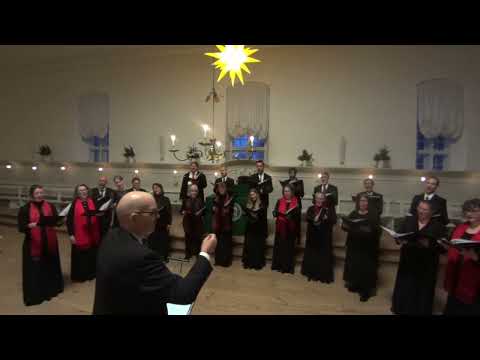
Bright and Glorious is the Sky - Laestadian Lutheran Church


Bright and glorious is the sky,
Radiant are the heavens high
Where the golden stars were shining
And their rays to earth inclining,
Beckoning us to heaven above,
Beckoning us to heaven above.

On that holy Christmas night
Through the darkness beamed a light
All the stars above were paling,
All their luster slowly failing,
As the Christmas star drew nigh,
As the Christmas star drew nigh.

Sages from the East afar,
When they saw this wondrous star,
Went to the find the King of nations,
And to offer their oblations
Unto Him as Lord and King,
Unto Him as Lord and King.

Him they found in Bethlehem,
Yet He wore no diadem;
They but saw a maiden lowly
With an Infant pure and holy,
Resting in her loving arms,
Resting in her loving arms.

Guided by the star they found
Him Whose praise the ages sound,
We too have a star to guide us
Which forever will provide us
With the light to find our Lord,
With the light to find our Lord.

As a star God’s holy Word
Leads us to our King and Lord;
Brightly from its sacred pages
Shall this light throughout the ages
Shine upon our path of life,
Shine upon our path of life.


If you made it this far, have a music filled 2026, and spread the word about these wonderful carols!
Vinny

Monday, January 5, 2026

Twelve Days of Christmas

Day 12 - Wassail! Wassail! All Over The Town (The Gloucester Wassail)

Through the years there have been many different variations of the lyrics, chorus, and number of stanzas sung for The Gloucester Wassail, depending on the historical time period, geographic location, and individual circumstance. The underlying tune used for the lyrics has also altered considerably, depending on similar factors. However the current version of the tune is documented to have existed for at least several hundred years. The sheet music published in William Henry Husk's Songs of the Nativity (1868), which contains the oldest reference of it being sung (in the 1790s), resembles the modern version, and in the oldest known sheet music publication in the Times Telescope (1813), the tune also resembles the one still sung today. (note from Wikipedia)

Refrain
Wassail! wassail! all over the town,
Our toast it is white and our ale it is brown;
Our bowl it is made of the white (green) maple tree;
With the wassailing bowl, we'll drink to thee.

1. Here's to our horse, and to his right ear,
God send our master a happy new year:
A happy new year as e'er he did see,
With my wassailing bowl I drink to thee.  Refrain

2. So here is to Cherry and to his right cheek
Pray God send our master a good piece of beef
And a good piece of beef that may we all see
With the wassailing bowl, we'll drink to thee.  Refrain

3. Here's to our mare, and to her right eye,
God send our mistress a good Christmas pie;
A good Christmas pie as e'er I did see,
With my wassailing bowl I drink to thee.  Refrain

4. So here is to Broad Mary and to her broad horn
May God send our master a good crop of corn
And a good crop of corn that may we all see
With the wassailing bowl, we'll drink to thee.  Refrain

5. And here is to Fillpail and to her left ear
Pray God send our master a happy New Year
And a happy New Year as e'er he did see
With the wassailing bowl, we'll drink to thee.  Refrain

6. Here's to our cow, and to her long tail,
God send our master us never may fail
Of a cup of good beer: I pray you draw near,
And our jolly wassail it's then you shall hear.

7. Come butler, come fill us a bowl of the best
Then we hope that your soul in heaven may rest
But if you do draw us a bowl of the small
Then down shall go butler, bowl and all.

8. Then here's to the maid in the lily white smock,
Who tripp'd to the door and slipp'd back the lock;
Who tripp'd to the door and pull'd back the pin,
For to let these jolly Wassailers walk in.

9. Be here any maids? I suppose here be some;
Sure they will not let young men stand on the cold stone!
Sing hey O, maids! come trole back the pin,
And the fairest maid in the house let us all in.

10. Here's to Dobbin, and to his right ear,
God send our master a happy New Year;
A happy New Year as e'er he did see
With my Wassailing Bowl I drink to thee.

11. Here's a health to the ox and to his right eye,
Pray God send our master a good Christmas pie,
A good Christmas pie as e'er I did see
In the Wassail bowl we'll drink unto thee

12. Here's a health to the ox and to his right horn,
Pray God send our master a good crop of corn,
A good crop of corn as e'er I did see,
In the Wassail bowl we'll drink unto thee

13. Here's a health to the ox and to his long tail,
Pray God send our master a good cask of ale,
A good cask of ale as e'er I did see,
In the Wassail bowl we'll drink unto thee

14 . . . and many others . . .

Wassail! Wassail! All Over The Town - The Waverly Consort [Refrain, 3, 4, 5, 6, 7, 8, 9]


Wassail! Wassail! All Over The Town - The Longest Johns [Refrain, 2, 10, 7, 8]


Wassail! Wassail! All Over The Town - arr. by Ralph Vaughan Williams [Refrain, 11, 12, 13, 7, 8]


Sunday, January 4, 2026

Twelve Days of Christmas

Day 11 - In the Ending of the Year

The words for this carol are from the 12th century anonymous German carol In hoc anni circulo (In the Year's Circle). This text was translated by Rev. John Mason Neale and published in his Medieval Hymns (1863).  Neale noted that In hoc anni circulo is "one of the most popular of Christmas Carols, and is found with greater variations than almost any other. There is scarcely a European language which has not had an ancient translation." In 1908 George Radcliffe Woodward reinterpreted Neale's translation and published it in his Songs of Syon. The melody (from the Jistebnicz Kantional, circa 1420) was then harmonized by Woodward for his collection.

The version of In the Ending of the Year we'll hear today, however, is by composer Peter Niedmann, written in 1994 and employing five of Woodward's original ten verses.

1. In the ending of the year
Light and life to man appear:
And the Holy Babe is here,
By the Virgin Mary.
For the Word becometh flesh
By the Virgin Mary.

2. Adam ate the fruit and died,
But the curse, that did betide
All his sons, is turn’d aside 
By the Virgin Mary.
For the Word becometh flesh
By the Virgin Mary.

3. Noah shut the Ark of old,
When the flood came, as is told:
Us its doors to-day enfold 
By the Virgin Mary.
For the Word becometh flesh
By the Virgin Mary.

4. Every creature of the plain
Own’d the guileful serpent’s reign;
He this happy day is slain 
By the Virgin Mary.
For the Word becometh flesh
By the Virgin Mary. 

5. Wherefore let our quire to-day 
Banish sorrow far away, 
Singing and exulting aye 
With the Virgin Mary.
For the Word becometh flesh
By the Virgin Mary.


In the Ending of the Year - Harvard University Choir


Saturday, January 3, 2026

Twelve Day of Christmas

Day 10 - A la venue de Noël

In 17th century France secular noëls (carols) from Provence associated with the miracle of the Nativity were not allowed to be sung during Mass. Composers like Balbastre, Daquin, and Corrette found a way around this ban: they arranged them for the organ. One approach to transcribing these noëls was very inventive and playful: the theme is presented, then varied using specific registers of the organ (oboe, cromorne, flute) to imitate the rustic instruments of shepherds. One such Provençal noël, by composer Nicolas Saboly (1614-1675), is A la venue de Noël (The Arrival of Christmas).

1. A la venue de Noël
   At the coming of Christmas,
Chacun se doit bien réjouir
   Everyone should rejoice,
Car c'est un testament nouvel
   For it is a new covenant
|: Que tout le monde doit tenir. :|
   That everyone must uphold.

2. Quand par son orgueil, Lucifer
   When, through his pride, Lucifer
Dedans l'abîme trébucha
   Stumbled into the abyss,
Nous conduisant tous en enfer
   Leading us all to hell,
|: Le Fils de Dieu nous racheta. :|
   The Son of God redeemed us.

3. Incontinent que Dieu fut né
   As soon as God was born,
L'ange l'alla dire aux pastours
   The angel went to tell the shepherds,
Qui se prirent tous à chanter
   Who all began to sing,
|: Sonnant chevrettes et tambours. :|
   Playing pipes and drums.

4. Après un bien petit de temps
   After a very short time,
Trois rois le vinrent adorer
   Three kings came to adore him,
Portant la myrrhe avec l'encens
   Bringing myrrh and frankincense,
|: Et l'or qui est fort à priser. :|
   And gold, which is highly prized.

5. Là, virent le doux Jésus-Christ
   There, they saw the sweet Jesus Christ,
Et la mère qui le porta
   And the mother who bore him,
Celui qui tout le monde fit
   He who created the whole world,
|: Et les pécheurs ressuscita. :|
   And resurrected sinners.

6. Bien apparut qu'il nous aima
   It was clearly shown that he loved us
Quand à la croix pour nous fut mis
   When he was placed on the cross for us;
Dieu le Père qui tout créa
   God the Father, who created all,
|: Nous donne à la fin Paradis. :|
   Gives us Paradise in the end.

A la venue de Noël


A la venue de Noël - arr. by Christophe Gautier / Maîtrise Notre-Dame de Paris


. . . and an organ variation on A la venue de Noël by Claude Bénigne Balbastre.

A la venue de Noël - Robert Lehman, organ


Thursday, January 1, 2026

Twelve Days of Christmas

Day 9 - Adoração dos pastores (The Adoration of the Shepherds)

The tradition of singing Christmas carols is celebrated in most Christian countries, from the Philippines to Poland, passing through Greece and Ukraine. Even in less cold Christmases, such as in Australia and New Zealand, there is a custom of singing by candlelight on the nights preceding and following December 25th. On the Iberian Peninsula, various cultural differences gave rise to different ways of singing Christmas carols. In Spain, Villancicos, inspired by medieval dances, are popular; in Portugal, the theme is its own; poets like Camões used the form, but applied it to themes that were anything but Christmas related.

The story of The Adoration of the Shepherds (Adoração dos pastores) in Christmas carols harks back to the biblical narrative of the shepherds who were the first to receive the news of Jesus' birth, symbolizing humility, simplicity, and God's acceptance of the marginalized. These events have been transformed into hymns and songs that celebrate this encounter with the Savior, reinforcing the message of love and gratitude.

Um pastor vindo de longe
   A shepherd from afar
À nossa porta bateu
   Knocked at our door
Trouxe recados que dizem
   He brought tidings that say
O Deus menino nasceu.
   The Baby God is born.

Este recado tivemos
   We received this message
Já meia noite seria
   It was already midnight
Estrelas do céu lá vamos
   Stars in the sky, let's go
Dar parabéns a Maria.
   To congratulate Mary.

Vamos ter com os mais pastores
   Let's go with the other shepherds
Não se percam no caminho
   Don't get lost on the way
Vamos todos e depressa
   Let's all go quickly
Visitar o Deus Menino.
   To visit the Baby God.

Ai, que formoso Menino!
   Oh, what a beautiful Child!
Ai, que tanta graça tem!
   Oh, what grace He has!
Ai, que tanto se parece
   Oh, how much He resembles
Com sua Senhora Mãe!
   His Lady Mother!

Adoração dos pastores - arr. Mário Nascimento / Coro Ninfas do Lis (Portugal)


Adoração dos pastore - arr. by Carlos Santos Silva / Coral a cappelas


Adoração dos pastores - Coro Areias de Vilar (Portugal)


Twelve Days of Christmas - New Year’s Day

Day 8 - Some New Year’s Day Songs!

The Shepherd's Carol . . . to be sung on New Year's Day

The New Year is begun,
Good morrow, my masters all!
The cheerful rising sun
Now shining in this hall,
Brings mirth and joy to man and boy
With all that here doth dwell;
Whom Jesus bless with love's increase
So all things shall prosper well.

A New Year's gift I bring
Unto my master here,
Which is a welcome thing
Of mirth and merry cheer.
A New Year's lamb come from thy dam
An hour before daybreak;
Your noted ewe doth this bestow,
Good master, for your sake.

And to my dame so king
This New Year's gift I bring;
I'll bear an honest mind
Unto her while I live.
Your white-wooled sheep I'll safely keep
From harm of brush or briar,
That garments gay for your array
May clothe you the next New Year.

And to your children all,
These New Year's gifts I bring;
And though the price be small,
They're fit for queen or king:
Fair pippins red kept in my bed
A-mellowing since last year,
Whose beauty bright so clear of sight
Their hearts will glad and cheer.

And to your maids and men
I bring both points and pins;
Come bid me welcome then,
The good New Year begins;
Thy office show before I go,
My bottle and bag come fill;
And for thy sake I'll merry make
Upon the next green hill.

The Shepherd's Carol - Passamezzo


Young Men and Maids On New Year's Day . . . a carol for New Year's Day

Young men and maids on New Year's Day,
Their loves they will present
With many a gift both fine and gay,
Which gives them true content:
And though the gift be great or small,
Yet this is the custom still
Expressing their loves in ribbons and gloves,
It being their kind good-will.

Fine ruffs, cravats of curious lace
Maids give them fine and neat;
For this the young men will them embrace
With tender kisses sweet:
And give them many pleasant toys
To deck them fine and gay,
As bodkins and rings with other fine things
For the honour of New Year's day.

Young Men and Maids On New Year's Day - Passamezzo


Wednesday, December 31, 2025

Twelve Days of Christmas - New Year’s Eve

Day 7 - The Moon Shines Bright (The Bellman's Song)

The Moon Shines Bright is a carol much in use in the midland and western counties of England. A shorter version was issued by the Seven Dials printers and likewise on west-country broadsides under the title of The Bellman. In the Seven Dials copy the fourth line of the first verse runs, "And hark! the bellman of the night." The functionary known in bygone times as the Bellman was a kind of night watchman, who, in addition to his staff and lantern, carried a bell, and at a certain period of the year was wont to arouse the slumbering inhabitants of the town to listen to some such effusion as that which is given below. For this service (?!) he looked for some gratuity at Christmas. (from the Hymns and Carols of Christmas)

1. The moon shines bright and the stars give light
A little before the day
Our Lord, Our God, he called on us
   [And hark! the bellman of the night]
And bid us awake and pray!

2. Awake, Awake! good people all
Awake and you shall hear
The Lord our God, died on the cross
For us he loved so dear

3. O fair, O fair Jerusalem,
When shall I come to thee?
When shall my sorrows have an end,
Thy joy that I may see?

4. The fields were green as green could be,
When from His glorious seat,
Our Lord, our God, he watered us,
With His heavenly dew so sweet.

5. And for the saving of our souls
Christ died upon the cross,
We ne'er shall do for Jesus Christ
As he has done for us.

6. For the life of a man is but a span,
And cut down in its flower,
We are here to-day, and to-morrow gone,
We are all dead in an hour. [a creature of an hour]

7. O pray teach your children, man
The while that you are here;
It will be better for your souls,
When your corpse lies on the bier.

8. To-day you may be alive, dear man 
Worth many a thousand pound;
To-morrow may be dead, dear man,
And your body be laid under ground.

9. With one turf at your head, O man,
And another at your feet;
Thy good deeds and thy bad, O man,
Will all together meet.

10. My song is done, I must be gone,
I can stay no longer here;
God bless you all, both great and small,
And send you a happy (joyful) New Year!

First, a very classic rendition . . .

The Moon Shines Bright - Magdalen College Choir
   [verses 1, 2, 3, 4, 5, 10]


. . . next, a much more folk-like performance . . .

The Moon Shines Bright - Coope, Boyes, Simpson
   [verses 1, 2, 5, 6, 10]


 . . . and a solo version with all ten verses . . . 
The Bellman's Carol (The Moon Shines Bright) - Baltimore Consort


. . .  an organ prelude reflection on the tune . . .

Prelude on The Moon Shines Bright - Robin Milford, composer; Andrew Seivewright, organ


. . . and lastly, as is often the case, a modern version inspired by the ancient words . . .

The Bellman's Song - Malcolm Archer, composer
   [verses 1, 2, 3, 5, 6]


Tuesday, December 30, 2025

Twelve Days of Christmas

Day 6 - To Shepherds As They Watched

This carol sent me down a surprisingly deep rabbit hole as I tried to come up with some interesting things to say about it. The basics are straightforward . . .

The original hymn, Vom Himmel kam der Engel Schar (From Heaven Came a Host of Angels), was written by Martin Luther in 1532, based on readings from the Bible in Luke ii. 10, 11, and Matthew, ii. 6. Luther apparently wrote these verses because his first Christmas hymn, the fifteen stanza Vom Himmel hoch o Engel kommt (From heaven above, O angels, come) was considered too long. The verses celebrate Christ's birth with "glad tidings," the arrival of the Christ-child as Savior, and an invitation to all to come to the manger. Vom Himmel kam der Engel Schar is one of only two hymns preserved in Luther’s own handwriting.

1) Vom Himmel kam der Engel Schar,
     From heaven came a host of angels,
erschien den hirten offenbar;
     appearing openly to the shepherds;
sie sagten ihn’: „Ein Kindlein zart,
     they said to them: "A tender child,
das liegt dort in der Krippen hart.
     lies there in the hard manger.

2) zu Bethlehem, in Davids Stadt,
     In Bethlehem, in David's city,
wie Micha das verkündet hat,
     as Micah has prophesied,
es ist der herre Jesus Christ,
     it is the Lord Jesus Christ,
der euer aller Heiland ist.
     who is the Savior of you all.

3) Des sollt ihr alle fröhlich sein,
     Therefore, you should all be joyful,
daß Gott mit euch ist worden ein.
     that God has become one with you.
Er ist geborn eu’r Fleisch und Blut,
     He is born of your flesh and blood,
eu’r Bruder ist das ewig Gut.
     your brother is the eternal Good.

4) Was kann euch tun die Sünd und Tod?
    What can sin and death do to you?
Ihr habt mit euch den wahren Gott;
    You have the true God with you;
laßt zürnen Teufel und die Höll,
    let the devil and hell rage,
Gottes Sohn ist worden eu’r Gesell.
    God's Son has become your companion."

5) Er will und kann euch lassen nicht,
     He will and can never leave you,
setzt ihr auf ihn eu’r Zuversicht;
     if you place your trust in Him;
es mögen euch viel fechten an:
     many may fight against you:
dem sei Trotz, der’s nicht lassen kann.
     defy him who cannot desist.

6) Zuletzt müßt ihr doch haben recht,
     In the end you must prevail,
ihr seid nun worden Gotts Geschlecht.
     you have now become God's offspring.
Des danket Gott in Ewigkeit,
     Therefore thank God for all eternity,
geduldig, fröhlich allezeit.
     patient and joyful at all times.

It is set to the tune Puer nobis nascitur from the 1582 collection Piae Cantiones (Pious Songs), and the two most famous and widely used harmonizations of the hymn are by Michael Praetorius (1609) and George Ratcliffe Woodward (1910).

Puer nobis nascitur (chant)


Puer nobis nascitur - Montreal Compline Choir


Puer nobis nascitur (Michael Praetorius) - Gabrielli Consort


Next we turn to the English version of Luther's hymn, or should we say, one of the English versions, and one that follows the original very closely. This is the 1854 translation by Richard Massie, To Shepherds As They Watched By Night (below). Here's where my search got tangled and messy. One would think that Massie's fine translation would receive some outstanding performances online. That is not the case as of Christmas 2025. There are a number of "pop" and "contemporary" sounding versions using Massie's words, but no performances by professional choirs. And the only videos presenting the lovely George Ratcliffe Woodward harmonization are by a number of pianists who recorded the arrangement in lieu of a full choir.

1. To shepherds as they watched by night
Appeared a host of angels bright;
Behold the tender Babe, they said,
In yonder lowly manger laid.

2. At Bethlehem, in David's town,
As Micah did of old make known;
'Tis Jesus Christ, your Lord and King,
Who doth to all salvation bring.

3. Oh, then rejoice that through His Son
God is with sinners now at one;
Made like yourselves of flesh and blood,
Your Brother is the eternal God.

4. What harm can sin and death then do?
The true God now abides with you.
Let hell and Satan rage and chafe,
Christ is your Brother--ye are safe.

5. Not one He will or can forsake
Who Him his confidence doth make.
Let all his wiles the Tempter try,
You may his utmost powers defy.

6. Ye shall and must at last prevail;
God's own ye are, ye cannot fail.
To God forever sing your praise
With joy and patience all your days.

To Shepherds As They Watched By Night - George Ratcliffe Woodward harmonization; Andrew Remillard, piano


All this searching then led me to other recordings of choirs singing the same music, but to different texts. Which then steered me to producing a list of other texts that use the 16th century tune as an underlay - some English transformations of Luther's original ideas, and others quite unrelated to Luther's words or Christmas at all . . . even though Puer nobis nascitur is a medieval Christmas carol. Here's what I found:

Hymns using the tune Puer nobis nascitur, from Piae Cantiones (1582):
 - A Little Child the Savior Came
 - All Praise to Thee, Eternal Lord
 - As Angels Joyed with One Accord
 - As It Fell Upon a Night
 - Come Join with Me
 - Come, Thou Redeemer of the Earth
 - Creating Spirit, Holy Lord
 - Creator of the Stars of Night
 - Emmanuel, We Sing Thy Praise
 - Epiphany of Wisdom's Dawn
 - Father in Heav'n, Who Lovest All
 - Good News from Heaven the Angels Bring
 - Jesus Christ the Lord is Born
 - Joy Dawned Again on Easter Day
 - The Lord Whom Earth and Sea and Sky
 - My Song Forever Shall Record (Psalm 89)
 - My Soul Doth Magnify the Lord
 - O Father, Listen to Our Prayer
 - O God, You Are My God Alone
 - O Lord of Hosts, Almighty King
 - O Lord, Thy People Gathered Here
 - O Love Divine, Who's Constant Beam
 - O Love, How Deep, How Broad, How High
 - O Splendor of God's Glory Bright
 - O That I Could Forever Dwell
 - O Thou Whose Gracious Presence Shone
 - On Jordan's Bank the Baptist's Cry
 - That Easter Day with Joy was Bright
 - These Treasured Children
 - Thou Lord of Hosts, Whose Guiding Hand
 - 'Tis Winter Now, the Fallen Snow
 - To Shepherd's as They Watched by Night
 - Unto Us a Boy is Born
 - Unto Us is Born a Son
 - The Virtue of Humility
 - We Are But Little Children Poor
 - We Praise Thee, God, for Harvests Earned
 - What Star is This, with Beams So Bright

Here's one of the best performances that I could find, by a choir singing the music of Puer nobis nascitur and the words What Star is this, with Beams So Bright

The Redeemer Choir


1. What star is this, with beams so bright,
More lovely than the noonday light?
’Tis sent to announce a newborn king,
Glad tidings of our God to bring.

2. ’Tis now fulfilled what God decreed,
“From Jacob shall a star proceed;”
And lo! the eastern sages stand
To read in heav’n the Lord's command.

3. O Jesus, while the star of grace
Impels us on to seek thy face,
Let not our slothful hearts refuse
The guidance of thy light to use.

4. To God the Father, heav’nly Light,
To Christ, revealed in earthly night,
To God the Holy Spirit raise
An endless song of thankful praise!


And here's a beautiful organ prelude on the same tune . . . 

Prelude on To Shepherds As They Watched By Night - Paul Manz, composer; Yasmin Phillip, organ


And LASTLY(!), a fine version of a variation on the Puer nobis nascitur tune (in 4/4 time instead of 3/4 time) and to the words As It Fell Upon A Night

arr. by Katherine K. Davis - Duqeusne University Chamber Singers


1. As it fell upon a night
In the winter weather,
Angels bright in starry height
Began to sing together.

2. Shepherds sleeping on the plain
Woke to see the glory,
All amazed they stood and gazed
And heard the angels’ story.

3. Unto you a child is born
In a manger lowly,
Humble, He, yet born to be
The King of Love most holy.

4. In a manger now He lies,
ox and ass before Him;
All the world at last shall come
to worship and adore Him.”

5. Though it be a winter night,
Love is still appearing!
Through the sound of war and woe
that song we still are hearing.

6. Happy angels from afar,
Cease your singing never!
In excelsis gloria!
Forever and forever.

Monday, December 29, 2025

Twelve Days of Christmas

Day 5 - В Віфлеємі новина (News in Bethlehem)

News in Bethlehem is a Transcarpathian Christmas carol. Transcarpathia is a unique, multicultural region in western Ukraine, situated south of the Carpathian Mountains, known for its blend of Ukrainian, Hungarian, Slovak, and other European cultures, distinct cuisine, castles, and historical status as part of various states, now forming Ukraine's westernmost oblast, bordering Slovakia, Hungary, and Romania. It's characterized by its varied landscapes, unique dialect, and rich heritage influenced by its crossroads location, distinct from other Ukrainian lands due to its mountain isolation.

The carol tells this story: In Bethlehem, News! The Virgin gave birth to a Son, gave birth in grace. The immaculate Virgin is the Mother Mary. She laid him in the manger in a stable in Bethlehem. Joseph comforts the Virgin and helps Mary to swaddle. Glory to God and praise Him. The nativity scene has come: Angels come from heaven, with the Son of God, and they glorify Mary. In the dark night, a strange light strikes the eyes – a bright star showing where Mary has given birth to the Child Jesus. Not far away, shepherds grazed their flock in the valley. They travel to the manger to see Mary and her Child.

In Bethlehem today the news:
The Most Pure Virgin gave birth to a Son,
|: Swaddled in a manger, among the cattle,
The God rested on the hay, unclothed. :| (2X)

Already the Cherubim sing glory,
The angelic choirs of the Lord soar,
|: The poor shepherd carries what he can,
To bestow gifts on the Child of God. :|

And the bright star of the world cries out:
The Messiah brings joy, happiness!
|: To Bethlehem, all of you, hasten now,
Welcome God in the poor Child! :|

Following the light of the star somewhere from the east
Three lords of princely lineage come,
|: Gold, gifts, incense, myrrh
At once with a pure heart they bring as an offering. :|

Mary, the Mother of her Son, cherishes her Son,
Joseph, the old man, warms the swaddling clothes,
|: And the King of the universe in winter and pain
Blesses us for a better fate. :|

Dear Jesus, we are not rich,
We cannot give you gifts of gold,
|: But we bring a gift more precious than peace,
This is the faith of the heart, this is sincere love. :|

Look with a sincere eye, O Son of God,
On our land, on Ukraine,
|: Send her a great gift from heaven,
So that she may glorify You forever and ever. :|

News in Bethlehem - Ternopil Theological Greek-Catholic Seminary


News in Bethlehem - Honored Academic Transcarpathian Folk Choir


Saturday, December 27, 2025

Twelve Days of Christmas

Day 4 - Coventry Carol (Lullaby Carol)

This carols is one of many songs and hymns that relate to the Feast Day of the Holy Innocents, December 28th. The Coventry Carol - also know as the Lullaby Carol - is an English Christmas carol dating from the 16th century. It was traditionally performed in Coventry, England as part of a mystery play called The Pageant of the Shearmen and Tailors. The play depicts the Christmas story as described in Matthew, Chapter 2 in the Bible. The carol references the Massacre of the Innocents, in which Herod ordered all male infants under the age of two in Bethlehem to be killed, and takes the form of a lullaby sung by the mothers of the doomed children. The oldest known text of the carol was written down by Robert Croo in 1534, and the oldest known melodic setting dates from 1591.

The words of the carol focus on grief, lamentation, and the human cost of Herod’s decree, using simple, repetitive language to evoke emotional intensity. Lines such as Lully, lullay, thou little tiny child function as a cradle song, blending tenderness with tragedy. This juxtaposition of lullaby and lament highlights the vulnerability of the infant Jesus and the surrounding suffering, deepening the carol’s emotional resonance and theological reflection on the contrast between human sin and divine salvation. (thanks to  Hymnallibrary.com)

Refrain
Lully, lulla
Thou little tiny Child
By by, lully, lullay

O sisters too,
How may we do,
For to preserve this day?
This poor Youngling
For Whom we do sing
By by, lully, lullay?  (Refrain)

Herod the king,
In his raging,
Chargèd he hath this day
His men of might,
In his own sight,
All young children to slay.  (Refrain)

That woe is me,
Poor Child for Thee!
And ever morn and may,
For thy parting
Neither say nor sing,
By, by, lully, lullay.


Coventry Carol - The Anúna Collective (arr. Michael McGlynn)


Coventry Carol - Voces8 U.S. Scholars (arr. by Barnaby Smith)


. . . and another version by composer Kenneth Leighton

Coventry Carol - King's College Choir


Twelve Days of Christmas

Day 3 - Patapan

Burgundy is the region in eastern France which is one of France's prime areas for the development of noëls (carols). Much of the carol activity in Burgundy came from the pen of the French lawyer and poet Bernard de la Monnoye (1641-1728), the carol poet laureate of Burgundy. Several of his Christmas poems are still in print today. All of Monnoye's carols, written in the Burgundian dialect, were composed around 1700 and set to folk tunes, though some of the music may have been written by Monnoye himself. The carol Patapan was first published in his collection Noël borguignon (1700) with the title Guillô, pran ton tamborin (Willie, Bring Your Little Drum). The carol revolves around the birth of Jesus, and is told from the perspective of children playing simple instruments (flutes and drums), with onomatopoeic sounds mimicking the sounds of the instruments - "patapan" mimics the sound of the drum, "tu-re-lu-re-lu" the flute. 

The carol features two boys, Guillô (Willie) and Robbin, who are taught to praise God and rejoice at the birth of Christ by playing upon the drum and flute. Willie and Robin were common characters in old French carols (like Peter, Mary, Jack and Jill in English nursery rhymes), and the praise they give is symbolic of the village community as a whole giving praise to God. It has been translated numerous times into English (see here), each giving its own take on the original text.

Here's the first verse in the original Burgundian dialect (with a literal English translation):
Guillô, pran ton tamborin / William, take your drum
Toi, pran tai fleute Robbin / You, take your flute, Robin
Au son de ces instruman / To the sound of these instruments
Turelurelu, patapatapan / Tu-re-lu-re-lu, pata-pata-pan
Au son de ces instruman / To the sound of these instruments
Je diron Noei gaiman / I will say Christmas cheerfully


And now the full carol, in modernized French, again with a literal English translation:
Guillaume, prends ton tambourin
     William, take your tambourine,
Toi, prends ta flûte, Robin
     You, Robin, take your flute.
Au son de ces instruments
     To the sound of these instruments,
Turelurelu, patapatapan
     Turelurelu, patapatapan,
Au son de ces instruments
     To the sound of these instruments,
Je dirai Noël gaîment
     I will joyfully sing of Christmas.

C'était la mode d’autrefois
     It was the custom of old,
De louer le Roi des rois
     To praise the King of Kings,
Au son de ces instruments
     To the sound of these instruments,
Turelurelu, patapatapan
     Turelurelu, patapatapan,
Au son de ces instruments
     To the sound of these instruments,
Il nous en faut faire autant
     We must do the same.

Ce jour le diable est vaincu
     This day the devil is vanquished,
Rendons-en grâce à Jésus
     Let us give thanks to Jesus.
Au son de ces instruments
     To the sound of these instruments,
Turelurelu, patapatapan
     Turelurelu, patapatapan,
Au son de ces instruments
     To the sound of these instruments,
Faisons la nique à Satan
     Let us defy Satan.

L'homme et Dieu sont plus d’accord
     Man and God are more in accord,
Que la flûte et le tambour
     Than the flute and the drum;
Au son de ces instruments
     To the sound of these instruments,
Turelurelu, patapatapan
     Turelurelu, patapatapan,
Au son de ces instruments
     To the sound of these instruments,
Chantons, dansons, sautons en
     Let us sing, dance, and leap for joy!


Here, now, is the English version used in David Conte arrangement:
Willie bring your little drum;
Robin bring your flute and come;
And be merry while you play,
Tu-re-lu-re-lu, Pa-ta-pa-ta-pan.
And be merry while you play,
On this joyful Christmas day!

When the men of olden days
To the king of Kings gave praise,
On the fife and drum did play,
Tu-re-lu-re-lu, Pa-ta-pa-ta-pan.
On the fife and drum did play,
On this joyful Christmas day!

God and man today become
More in tune than fife and drum;
So be merry while you play,
Tu-re-lu-re-lu, Pa-ta-pa-ta-pan.
So be merry while you play,
Sing and dance this Christmas day!

Pat-a-pan - Atlanta Master Chorale (arr. by David Conte)


And yet another translation, which is used in the next two videos:
Willie take your little drum,
With a whistle Robin come,
When we hear the fife and drum,
Tu-re-lu-re-lu, Pa-ta-pa-ta-pan.
When we hear the fife and drum
Christmas should be frolicsome.

So the people in those days (Thus the men of olden days)
Loved the King of Kings to raise,
When they hear the fife and drum,
Tu-re-lu-re-lu, Pa-ta-pa-ta-pan.
When they hear the fife and drum,
All the children soon will come. (Sure our children won't be dumb!)

God and man are now become
More at one than fife and drum
When you hear the fife and drum,
Tu-re-lu-re-lu, Pa-ta-pa-ta-pan.
When you hear the fife and drum,
Dance and make the village hum.

Pat-a-pan - Quadriga Consort


Pat-a-pan - Yura Lytkin & Friends


Thursday, December 25, 2025

Twelve Days of Christmas

Day 2 - There is no rose

Lucy Walker (b. 1998) is quickly establishing her place as one of Britain’s foremost emerging compositional voices. Her vibrant choral writing has been described as "full of light and beautifully crafted." Walker is passionate about making music - especially choral music - accessible and inclusive, and her compositions and her work teaching other upcoming musicians reflects this mission. Walker’s setting of There is no rose flows between swells of emotion and warm chromatic inflections in the Latin refrains. The piece captures the natural emphases of the anonymous 15th century text, seamlessly moving between irregular and simple time signatures. (from Oxford University Press)

Alleluia . . .

There is no rose of such virtue;
As is the rose that bare Jesu;
Alleluia.

For in this rose contained was
Heav’n and earth in little space;
Res miranda! [Wonderful thing!]

And by that rose we may well see
that he is God in persons three,
Pari forma. [Equal in form]

Now leave we all this worldly mirth,
And follow we this joyful birth.
Transeamus [Let us follow]
Allelula!


There is no rose - The Oxford Choir


Twelve Days of Christmas - Christmas Day

Christmas Day - The Virgin’s Slumber Song (Max Reger)

Some songs written especially for Christmas become so well known that they eventually are thought of as folk songs. The Virgin’s Slumber Song (Maria Wiegenlied) is an example of just the opposite turn of events. Originally a folk-song melody to the words Joseph Dearest, Joseph Mild, this graceful air was taken by the German composer Max Reger and transformed in 1912 into an art song, Maria Wiegenlied.  Edward Teschemacher supplied an English translation of this lovely song, which echoes part of Joseph Dearest, Joseph Mild: the Virgin Mary singing to her Baby while He sleeps. The rhythm of both melody and accompaniment suggests the cradle gently rocking. (notes from William L. Simon, Reader’s Digest Merry Christmas Songbook)

Maria sitzt im Rosenhag
     Dear Mary sits in rosy bow'r
Und wiegt ihr Jesuskind
     And rocks the Jesus child
Durch die Blätter leise
     Softly through the golden leaves
Weht der warme Sommerwind
     Drifts a breezes so gentle and mild.

Zu ihren Füßen
     At her feet 
Singt ein buntes Vögelein
     Sings a bird all gold and bright
Schlaf, Kindlein, süße
     Sleep, dear One, sweet, sweet one
Schlaf nun ein!
     Sleep good night!

Hold ist dein Lächeln
     Lovely is your gentle smile
Holder deines Schlummers Lust
     Telling of your slumber blessed
Leg dein müdes Köpfchen
     Lay your tired head so close
Fest an deiner Mutter Brust!
     Lay it on your mother's breast!
Schlaf, Kindlein, süße
     Sleep, dear One, sweet, sweet one
Schlaf nun ein!
     Sleep good night!


The Virgin’s Slumber Song - Sissel Kyrkjebø, soprano


Wednesday, December 24, 2025

Twelve Days of Christmas

Day 1 - Jesus, Jesus Rest Your Head

The Appalachian carol Jesus, Jesus, Rest Your Head was collected John Jacob Niles in Hardin County, central Kentucky in the early 20th century. Like so many other folk carols and hymns, the song’s origins predate by many decades its collection and publication. This gentle lullaby is sometimes titled alternatively The Manger Cradle Song, as the lyrics of the refrain take the form a soothing serenade to the sleeping Christ Child on that first Christmas night. (notes thanks to PBS)

Refrain
Jesus, Jesus, rest your head.
You has got a manger bed.
All the evil folk on earth
Sleep in feathers at their birth.
Jesus, Jesus, rest your head.
You has got a manger bed.

Have you heard about our Jesus?
Have you heard about his fate?
How his mammy went to the stable
On that Christmas Eve so late?
Winds were blowing, cows were lowing,
Stars were glowing, glowing, glowing.  Refrain

To the manger came the Wise Men.
Bringing gifts from hin and yon,
For the mother and the father,
And the blessed little Son.
Milkmaids left their fields and flocks
And sat beside the ass and ox.  Refrain


Jesus, Jesus Rest Your Head - John Jacob Niles, voice & dulcimer


Jesus, Jesus Rest Your Head - Seraphic Fire (arr. by Patrick Dupré Quigley)


Jesus, Jesus Rest Your Head - The Westminster Choir


Jesus, Jesus Rest Your Head - Worcester Cathedral Choir (arr. by A. Warrell)


Sunday, December 21, 2025

Twelve Days of Christmas

Day 2 - Don Oíche Ud i mBeithil (That Night in Bethlehem)

There are few Irish Christmas songs as beloved and evocative as Don Oíche Úd i mBeithil - a hauntingly beautiful carol that captures both the tenderness and mystery of Christmas Eve. The song tells the story of Christ’s birth through the lyrical beauty of the Irish language. The origins of Don Oíche Úd i mBeithil are somewhat mysterious. While many assume it is an ancient carol, the earliest known written versions date from the 17th or 18th century. However, its style and phrasing suggest it may have originated as part of Ireland’s oral folk tradition, passed down through generations of singers and storytellers before being written down. It is a staple of Irish Christmas celebrations, sung at midnight Mass, school concerts, and carol services throughout the country. More about the song . . . here

Don oíche úd i mBeithil / I sing of a night in Bethlehem
beidh tagairt faoi ghréin go brách / A night as bright as dawn
Don oíche úd i mBeithil / I sing of that night in Bethlehem
gur tháinig an Briathar slán / The night the Word was born

Tá gríosghrua ar spéartha / The skies are glowing gaily
's an talamh 'na chlúdach bán / The earth in white is dressed
Féach Íosagán sa chléibhín / See Jesus in the cradle
's an Mhaighdean 'Á dhiúl le grá / Drink deep in His mother's breast

Ar leacain lom an tsléibhe / And there on a lonely hillside
go nglacann na haoirí scáth / The shepherds bow down in fear
Nuair in oscailt gheal na spéire / When the heavens open brightly
tá teachtaire Dé ar fáil / And God's message rings out so clear

Céad glóir anois don Athair / Glory now to the Father
sa bhFlaitheasa thuas go hard / In all the heavens high
Is feasta fós ar sa thalamh / And peace to His friends on earth below
d'fheara dea-mhéin' siocháin / Is all the angels cry


Don Oíche Ud i mBeithil - Eabha McMahon


Don Oíche Ud i mBeithil - Celtic Women


Don Oíche Ud i mBeithil - Patrick Dexter, cello


Saturday, December 20, 2025

Twelve Days of Christmas

Day 3 - Joseph Dearest, Joseph Mild (Mine)

The text for this carol derives from Joseph, lieber Joseph mein, a verse from fourteenth or fifteenth century Germany. One of the earliest appearances of Joseph Dearest, Joseph Mild was as a lullaby sung by the Virgin Mary in a Mystery Play that flourished around Leipzig, Germany, in the early 1500s. The borrowed tune used was originally sung to a Latin text full of joy, Resonet in Laudibus (Let Our Praises Resound), dating from as early as the 14th century. Before that time, carols and other religious songs were danced and sung to primitive tunes and graceless texts. But a new awareness of beauty in worship swept through Europe in the 1500s, thanks in part to the Reformation, and melodies took on an ingratiating texture, while beautiful and evocative texts issued from the pens of genius poets. (notes from William L. Simon, Reader’s Digest Merry Christmas Songbook, 1981)

"Joseph, Dearest Joseph mine,
Help me cradle the Child divine.
God reward thee and all that’s thine,
In paradise," so prays the mother Mary.

Chorus
He came among us at Christmas time
At Christmas time in Bethlehem
Men shall bring him from far and wide,
Love’s diadem - Jesus, Jesus;
Lo, he comes and loves and saves and frees us.

"Gladly dear one, Lady mine
Help I cradle this Child of thine."
"God’s own light on us both shall shine,
In paradise," as prays the mother Mary.  Chorus

Peace to all that have goodwill!
God, who heaven and earth doth fill,
Comes to turn us away from ill,
And lies so still within the crib of Mary.  Chorus


Resonet in laudibus - Aurora Camerata


Resonet in laudibus cum iucundis plausibus
   Let praises ring out and joyful acclaim
Sion cum fidelibus: Apparuit quem genuit Maria.
   To Zion's faithful the Child born of Mary has appeared.
Gaudete, gaudate, Christus Natur hodie!
   Rejoice, rejoice, Christ is born!
Gaudete, gaudate, ex Maria Virgine.
   Rejoice, rejoice, from the Virgin Mary.

Pueri concinite, nato regi psallite,
   Let us sing together to the child,
   Let us sing to the newborn King
Voce pia dicite, Apparuit quem genuit Maria.
   and with the pious ones say:
   The Child born of Mary has appeared.
Gaudete, gaudate . . .

Sion lauda Dominum Saluatorem omnium,
   O Zion, praise the Lord, the Savior of mankind,
Virgo parit Filium. Apparuit quem genuit Maria.
   He who cleanses sin.
   The Child born of Mary has appeared.
Gaudete, gaudate . . .

Sancta tibi Trinitas, Os omnium gratias
   Give thanks to the holy trinity
   Let our voices give thanks
Resonet altissimas. Apparuit quem genuit Maria.
   And give the greatest praise.
   The Child born of Mary has appeared.
Gaudete, gaudate . . .


Joseph Dearest, Joseph Mild - The Westminster Choir


Joseph Dearest, Joseph Mild - The Dale Warland Singers


Twelve Days of Christmas

Day 4 - The Friendly Beasts

This song originally hails from a 12th century Latin song Orientis Partibus which first appeared in France and is usually attributed to Pierre de Corbeil, Bishop of Sens (died 1222). The tune is said to have been part of the Fete de l’Ane (The Donkey’s Festival), which celebrated the flight of the Holy Family into Egypt and was a regular Christmas observance in Beauvais and Sens, France in the 13th century. During the mass, it was common for a donkey to be led or ridden into the church. The words and tune were designed to give thanks for the ass on which Mary rode. Each verse was sung, and finished with the chorus "Hail, Sir donkey, hail." It was a solemn affair, but the tune became very popular in 17th and 18th century Germany.

Orientis partibus adventavit asinus
     From eastern parts a donkey came
pulcher et fortissimus, Sarcinis aptissimus
     Beautifu and strong, fit for loads

Hez, Sir Asnes, hez! / Hey, Sir Donkey, hey!

Saltu vincit hinnulos damas et capreolos
     He leaps over young males and bucks
super dromedarios velox madianeos
     Over the swift dromedaries of Midian

Hic in collibus Sychen iam nutritus sub Ruben
     Here on the hills of Sychen, brought up under Ruben
transiit per Jordanem saliit in Bethlehem
     He has crossed the Jordan and leapt into Bethlehem

Dum trahit vehicula multa cum sarcinula
     While he draws fully loaded carts
illius mandibula dura terit pabula
     His jaw grinds surely grinds the fodder

Cum aristis, hordeum comedit et carduum
     With ears he eats barley and thistles
triticum ex palea segregat in area
     He separates wheat from chaff on the threshing floor

Amen dicas, asine Iam satur ex gramine
     Amen, you donkey now full with grass
amen, amen itera aspernare vetera
     Amen, amen repeat the ancient aspersions

The song emigrated to England in the 12th century, where it began to take on its modern character. It is for this reason that some sources will give the origin of this song as England. The tune has been arranged in both 4/4 time (by Richard Redhead) and 3/4 time (Ralph Vaughan Williams). Robert Davis (1881-1950) apparently wrote the words that we normally associate with this tune in the 1920s. The first publication was in 1934. The Friendly Beasts is also known by the titles The Song of the Ass, or The Donkey Carol, or The Animal Carol and The Gift of the Animals. (a big thank you! to the Hymns and Carols of Christmas for all these detailed notes)

Jesus our brother, kind and good
Was humbly born in a stable rude
And the friendly beasts around Him stood,
Jesus our brother, kind and good.

"I," said the donkey, shaggy and brown,
"I carried His mother up hill and down;
I carried her safely to Bethlehem town."
"I," said the donkey, shaggy and brown.

"I," said the cow all white and red
"I gave Him my manger for His bed;
I gave him my hay to pillow his head."
"I," said the cow all white and red.

"I," said the sheep with curly horn,
"I gave Him my wool for His blanket warm;
He wore my coat on Christmas morn."
"I," said the sheep with curly horn.

"I," said the dove from the rafters high,
"I cooed Him to sleep so He would not cry;
We cooed him to sleep, my mate and I."
"I," said the dove from the rafters high.

Thus every beast by some good spell,
In the stable dark was glad to tell
Of the gift he gave Immanuel,
The gift he gave Immanuel.

"I," was glad to tell
Of the gift he gave Immanuel,
The gift he gave Immanuel.
Jesus our brother, kind and good.

Orientis Partibus - New London Consort


The Friendly Beasts - St. Olaf Choir (arr. by R. Scholz)


The Friendly Beasts - Vocal Essence Ensemble (Robert Farlee, composer)


The Friendly Beasts - Burl Ives


The Friendly Beasts - BlindPigAndTheAcorn (Paul and Pap)


Twelve Days of Christmas

Day 5 - Blessed Be That Maid Marie

Blessed Be That Maid Marie is an old English Christmas carol hailing the birth of Christ. The singers bless the Virgin, rejoicing that after thousands of years the day of Jesus' birth has finally arrived. This hymn is believed to have originated as early as the 15th century and is of unknown authorship. It employs both old English and Latin texts. Blessed Be That Maid Marie has also appeared with the titles Blyssid Be Yt Mayde Mary and Blyssid be that mayde Mary. The music derives from William Ballet's Lute Book - a collection of manuscripts dating from as early as 1590, and containing popular lute and viol pieces, as well as ballad tune arrangements.

Blessed be that Maid Marie;
Born He was of her body;
Very God ere time began,
Born in time the Son of man.

Refrain
Eya! Ihesus hodie
Natus est de Virgine.

In a manger of an ass
Jesus lay and lulled was;
Born to die upon the Tree
Pro peccante homine. Refrain

Sweet and blissful was the song
Changed of the Angel throng,
"Peace on earth," Alleluya.
In excelsis gloria. Refrain

Fare three Kings from far-off land,
Incense, gold and myrrh in hand;
In Bethlehem the Babe they see,
Stelle ducti lumine. Refrain

Make we merry on this fest,
In quo Christus natus est;
On this Child I pray you call,
To assoil and save us all. Refrain


Blessed Be That Maid Marie - The Cambridge Singers


Blessed Be That Maid Marie - Choir of Kings College, Cambridge (arr. Stephen Cleobury)


Blessed Be That Maid Marie - Trond Bengtson, lute (from William Ballet's Lute Book, setting and variations by Allan Alexander)


. . . and I couldn't help but add a number of other settings by composers who were inspired by these same beautiful words:

Blessed Be That Maid Marie - NTU Chorus (Korea) / Stephen Main, composer


Blessed Be That Maid Marie - arr. M. Zuccante


Blessed Be That Maid Marie - Amy Bebbington, composer


Friday, December 19, 2025

Twelve Days of Christmas

Day 6 - O Sanctissima (Oh, How Joyfully)

O Sanctissima is a Roman Catholic hymn in Latin, seeking the prayers of the Blessed Virgin Mary, and often sung in various languages on her feast days. The earliest known publication occured in London (1792), presenting it as a traditional song from Sicily. All early collectors implied an Italian origin, sometimes more specifically with the title The Sicilian Mariner's Prayer. Yet there is no early Italian publication of the melody, and no original source or date has been confirmed for this simple, yet beautiful melody or its poetic text. German poet Johann Gottfried Herder is said to have heard the hymn on a trip to Italy in 1788, and some years later - in 1807 - he published a German translation of it entitled O du fröhliche" (O, how joyfully). 

O Sanctissima O Piissima / O most holy, o most loving
Dulcis Virgo Maria / Sweet Virgin Mary
Mater amata intemerata / Beloved Mother, undefiled
Ora ora pro nobis / Pray, pray for us

Tota pulchraes O Maria / All beautiful, O Mary
Et macula non est in te / And without stain are you
Mater anmata intemerata / Beloved Mother, undefiled
Ora ora pro nobis / Pray, pray for us

Sicut lilium inter spinas / Like a lily among thorns
Sic Maria inter filias / So is Mary among her daughters
Mater amata intemerata / Beloved Mother, undefiled
Ora ora pro nobis / Pray, pray for us

In miseria in angustia / In our misery along the narrow path
Ora Virgo pro nobis / Pray for us, Virgin Maria
Pro nobis ora in mortis hora / 
Ora ora pro nobis / Pray, pray for us


O Sanctissima - Daughter's of St. Paul


O Sanctissima - Musica Cordis (arr. by Beethoven)


O Sanctissima - Bing Crosby, from the Bells of St. Mary's


And one last version . . . same text, but set by composer Paul Mealor

O Sanctissima - University of Aberdeen Chamber Choir


Thursday, December 18, 2025

Twelve Days of Christmas

Day 7 - Up Good Christen Folk

Up Good Christen Folk is based on a medieval song that was part of a collection compiled in Finland and first published in Sweden in 1582 as Piae Cantiones (Pious Songs). This collection contains Latin songs that were sung at that time in cathedral schools in Finland, many of which are still part of the repertoire of Swedish and Finnish choirs today. In 1853 a copy of Piae Cantiones was given to the composer John Mason Neale by G. J. R. Gordon, Her Majesty's Envoy and Minister at Stockholm. Neale then passed the book along to choirmaster Thomas Helmore. Helmore adapted the carol melodies and Neale either paraphrased the carol lyrics into English or wrote entirely new verses. Twelve revised selections from Piae Cantiones were then published as Carols for Christmastide (1853). In 1901 one of these carols was arranged for choir by the composer George Ratcliffe Woodward - who also provided the English text - and Up Good Christen Folk, as we know it today, appeared for the first time in The Cowley Carol Book (1902).

The carol is a celebration of the birth of Jesus Christ asking the “good Christen folk” to get up and listen to the bells ringing to welcome and adore him. (notes from FeeNotes.com)

Ding-dong, ding:
Ding-a-dong-a-ding:
Ding-dong, ding-dong:
Ding-a-dong-ding.

Up! good Christen folk, and listen
How the merry church bells ring,
And from steeple
Bid good people
Come adore the new-born King:

Tell the story how from glory
God came down at Christmastide,
Bringing gladness,
Chasing sadness,
Show'ring blessings far and wide.

Born of mother, blest o'er other,
Ex Maria Virgine,
In a stable
('Tis no fable),
Christus natus hodie.

Up Good Christen Folk - Choir of King's College, Cambridge


Twelve Days of Christmas

Epiphany - Bright and Glorious is the Sky The Epiphany , January 6, traditionally marks the end of Christmas and tells the story (from the ...